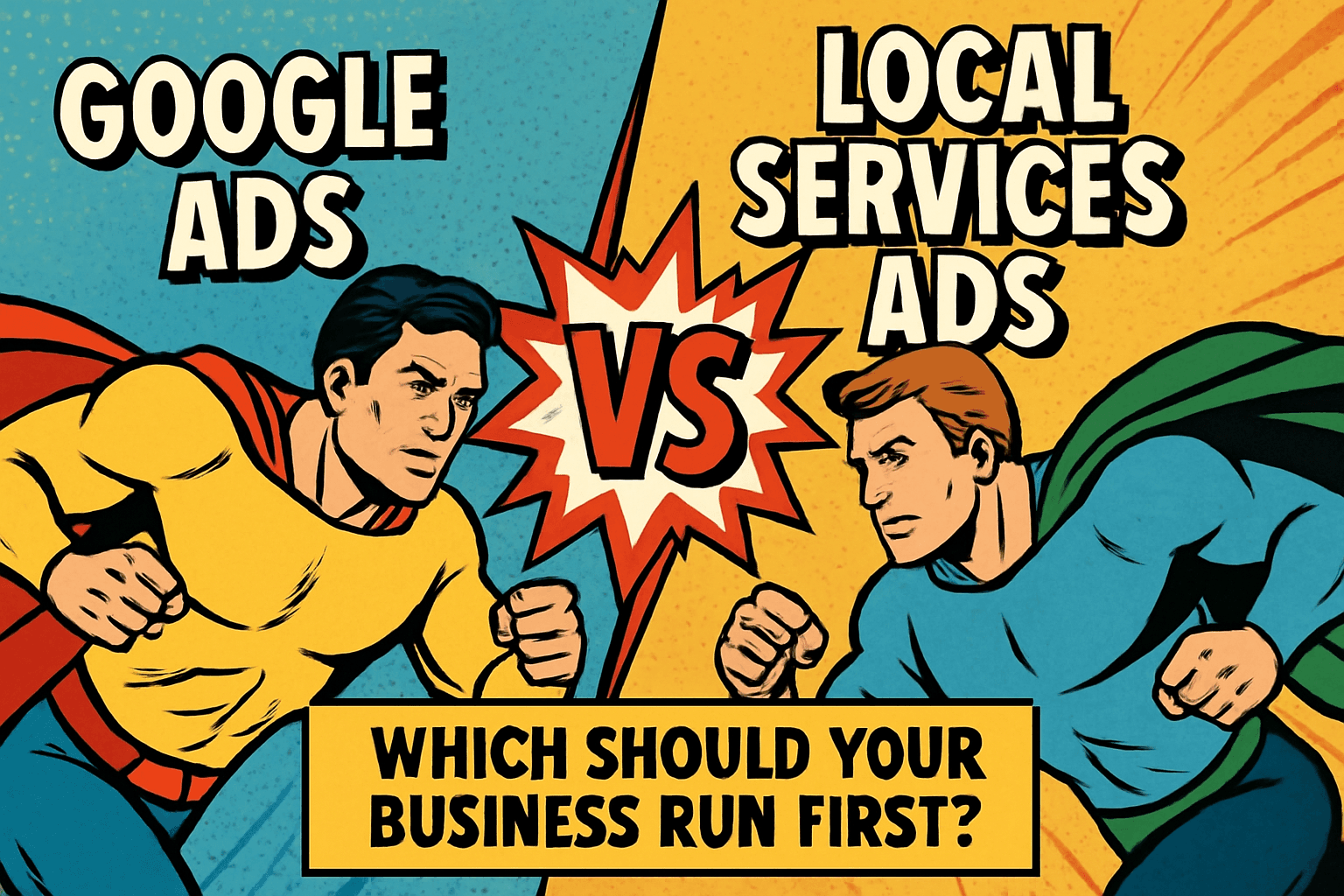
Google Ads vs. Local Services Ads: Which Should Your Business Run First?
Both platforms put your business at the top of Google, but they charge differently, rank differently, and fit different businesses. Here's how to decide which to launch first — and when to run both.
If you can only launch one paid platform this month, start with Local Services Ads (LSA) when your category qualifies and your reviews are solid — it's the lower-risk option because you only pay for actual leads. Start with Google Ads search campaigns when your category isn't LSA-eligible, when you need precise control over which keywords and landing pages you show up for, or when your review profile isn't strong enough yet to rank well in the LSA unit.
That's the short version. The honest, longer version is that these two platforms solve different problems and most local service businesses that qualify for both eventually run them side by side. Here's how each one actually works, what determines your cost on each, and a practical way to decide where to put your first dollar.
What Each Platform Actually Is
Google Ads search campaigns are the regular auction-based ads you're used to seeing below the map pack — you choose keywords, write ad copy, set bids, and pay per click regardless of whether that click ever turns into a customer. You control almost everything: which searches trigger your ad, what the ad says, and where the click lands.
Local Services Ads sit above regular search ads, above the map pack, and above organic results — the very first thing a searcher sees for many local queries. Instead of keywords and bids, an LSA listing shows your reviews, star rating, hours, and (in eligible categories) a Google Guaranteed or Google Verified badge. You set a weekly budget, and you're billed per lead — a call or message from a real customer — not per click.
PLATFORM BASICS
- Google AdsKeyword-based, pay per clickBelow map pack
- Local Services AdsReview-based, pay per leadAbove search ads and map pack
TWO DIFFERENT ENTRY POINTS TO THE SAME SEARCH RESULTS PAGE
The Pricing Model Difference: Per Click vs. Per Lead
This is the single biggest practical difference between the two platforms, and it changes how risk works for a new advertiser.
- Google Ads charges for every click, whether the visitor calls, fills out a form, or bounces immediately — so a weak landing page or loose keyword targeting burns budget on people who were never going to convert.
- Local Services Ads only charge when Google determines a call or message is a legitimate lead from a real customer in your category and service area — a curious click on your listing costs nothing.
- Invalid LSA leads (spam, wrong numbers, out-of-area contacts) can be disputed and credited back; a wasted Google Ads click cannot.
That makes LSA the structurally safer place to spend your first dollar — you're only ever paying for something that looks like a real opportunity. We cover the full mechanics of LSA pricing, including what determines your cost per lead, in our Local Services Ads cost guide.
Google Ads' upside is that you set the budget precisely and know your maximum exposure before you spend anything. Our Google Ads budget guide walks through the math — target clicks per day times cost per click times 30 — that most small businesses use to size a starting budget.
How You Rank on Each Platform
Ranking mechanics are where the two platforms diverge the most, and it changes what kind of business tends to win on each one.
Google Ads ranks on relevance and bid
Your ad rank depends on your bid, your Quality Score (a mix of expected click-through rate, ad relevance, and landing page experience), and the ad formats you're using. A well-run account with tight keyword themes and a fast, relevant landing page can outrank a bigger budget with sloppy targeting — but budget size still matters, especially in competitive categories.
Local Services Ads rank on reviews and responsiveness
Bid size barely factors into LSA placement. Instead, Google weighs your review count, average rating, and recency; how quickly you answer calls and reply to messages; your proximity to the searcher; and your booking rate. That means a smaller business with a strong, active review profile can regularly out-rank a bigger competitor who ignores their reviews — something that almost never happens in a straight Google Ads auction.
RANKING FACTORS
- Google AdsBID + QUALITY SCORE (CTR, RELEVANCE, LANDING PAGE)
- Local Services AdsREVIEWS, RESPONSE SPEED, PROXIMITY, BOOKING RATE
- Budget sizeMATTERS FOR GOOGLE ADS, BARELY FACTORS FOR LSA
DIFFERENT INPUTS DRIVE PLACEMENT ON EACH PLATFORM
Practically, this means the state of your Google Business Profile matters more for LSA success than it does for Google Ads. If your reviews are thin, that's the first thing to fix before expecting LSAs to perform.
Is Your Business Even Eligible for Local Services Ads?
Google Ads search campaigns are open to essentially any business with a website and a legitimate offer. Local Services Ads are not — they're limited to a specific set of categories, and eligibility is the first fork in this decision.
- Home services — plumbing, HVAC, electrical, contracting, moving, cleaning, and similar trades
- Business and professional services — lawyers, accountants, real estate agents, financial planners
- Health services — dentists, optometrists, and select medical practices
- Automotive — mechanics, auto body shops, and related repair services
- Beauty, wellness, learning, and personal care services in many markets
If your category isn't on Google's eligible list, the decision makes itself: Google Ads search campaigns are your top-of-page option, and there's no LSA alternative to weigh against them. Coverage also varies by location, so it's worth checking the signup flow directly for your specific city and category rather than assuming based on the general list.
Which Should You Run First?
Assuming your category qualifies for both, here's the practical framework we walk clients through.
- Check eligibility first. If you don't qualify for LSAs, this decision is already made — go with Google Ads.
- Look honestly at your review profile. If you have a healthy base of recent, authentic reviews, LSAs will likely rank well immediately. If your profile is thin or stale, either start rebuilding it before launching LSAs, or start with Google Ads while the review work runs in parallel.
- Consider how much control you need. If you're selling a specific, high-value offer (a particular service line, a promotion, a seasonal push), Google Ads lets you build keywords, ad copy, and a landing page around exactly that message. LSAs show one generic listing for your whole business.
- Weigh your risk tolerance. If you'd rather not risk a dollar on a click that doesn't convert while you're still learning what works, LSA's pay-per-lead model is the more forgiving place to start.
- Factor in your close rate on calls. LSA leads arrive as calls and messages you have to convert yourself; if your team is slow to answer the phone, that weakness will show up in your LSA cost efficiency fast, since response speed is a direct ranking input.
FIRST-PLATFORM DECISION PATH
- Not LSA-eligibleGoogle Ads
- Thin or stale reviewsGoogle Ads First
- Strong review profileLocal Services Ads
- Need precise keyword/offer controlGoogle Ads
- Low risk toleranceLocal Services Ads
ELIGIBILITY AND REVIEW STRENGTH DRIVE THE STARTING POINT
In practice, home-services and auto-repair businesses with solid reviews and an eligible category tend to see faster, lower-risk traction from LSAs first. Businesses in ineligible categories, or those wanting precise control over campaigns and offers, do better starting with Google Ads. Our Belcrete Concrete case study and Magnolia Smog Check case study both show what disciplined Google Ads management alone can produce when LSA isn't the whole picture.
Can You Run Both? (Most Businesses Eventually Do)
Yes, and if your category is LSA-eligible, running both is usually the endpoint, not an either-or choice. The two platforms don't compete for the same real estate on the results page, so they don't cannibalize each other the way running two Google Ads campaigns on the same keywords would.
- LSAs capture the very top of the page — reviews, hours, and the verification badge doing the convincing — while Google Ads search campaigns cover everything below it, including searches and offers LSAs don't touch.
- The review work that improves your LSA ranking (a steady, authentic review pipeline) also strengthens your Google Business Profile and, by extension, your standing in the map pack — the same effort compounds in more than one place.
- Budget for the two doesn't have to compete directly, since LSA spend is bounded by your weekly lead budget and Google Ads spend is bounded by your daily campaign budget — you can size each independently around what you can actually fulfill.
The money spent on either platform is always billed directly to Google, separate from any management fee if you hire an agency to run the accounts.
Mistakes to Avoid When Choosing Between the Two
A few decision mistakes come up often enough that they're worth naming directly.
- Launching LSAs with a thin or stale review profile and expecting them to perform like Google Ads. Reviews are the ranking engine here — skipping that groundwork usually produces a live listing that almost nobody sees.
- Assuming LSA eligibility based on the general category list instead of checking the actual signup flow for your specific city and service. Coverage varies by location, and it's a five-minute check before you commit to a plan.
- Treating Google Ads keyword strategy as optional because 'LSAs will cover the top of the page.' LSAs only cover the specific services and searches Google matches you to — a separate campaign is still needed for offers and keywords outside that scope.
- Setting an LSA weekly budget above your actual job capacity. Since you're billed per lead rather than per click, an oversized budget just produces leads you have to turn away, which also hurts your booking-rate ranking factor over time.
- Comparing the two platforms purely on 'which is cheaper' rather than which fits the buying behavior of your category. A per-lead model and a per-click model aren't directly comparable dollar for dollar — measure both by cost per booked job, not cost per click or cost per lead in isolation.
Summary and Next Steps
Google Ads and Local Services Ads solve different problems: Google Ads gives you precise control and charges per click; LSAs charge per lead and rank on reviews and responsiveness rather than bids. If your category is LSA-eligible and your reviews are strong, start there — the pay-per-lead model is the lower-risk way to test paid visibility. If you're not eligible, need tight control over keywords and offers, or your review profile needs work first, start with Google Ads. Most local service businesses that qualify for both end up running them together.
- This week: check whether your category is LSA-eligible by starting the signup flow — it's free to see Google's suggested budget.
- Pull your current Google Business Profile review count and recency, since that determines how well you'd rank in the LSA unit today.
- If you're not LSA-eligible, look up real cost-per-click estimates for your top keywords in Google's Keyword Planner before setting a Google Ads budget.
- If you're already running one platform successfully, revisit whether the other is worth adding rather than assuming it's an either-or choice.
If you'd rather have someone look at your category, your reviews, and your market and tell you honestly which platform, or combination, makes sense to launch first, that's exactly what a free strategy call covers. We manage both Google Ads and Local Services Ads day to day. Where your category qualifies, Local Services Ads management is included in our Google Ads plans, so the honest question is where your first dollar of budget should go, and that is what we'll tell you.