How to Rank in the Google Map Pack: 3 Factors
The Google map pack is decided by three factors: relevance, distance, and prominence. Here is what each one means and how a local business improves them.
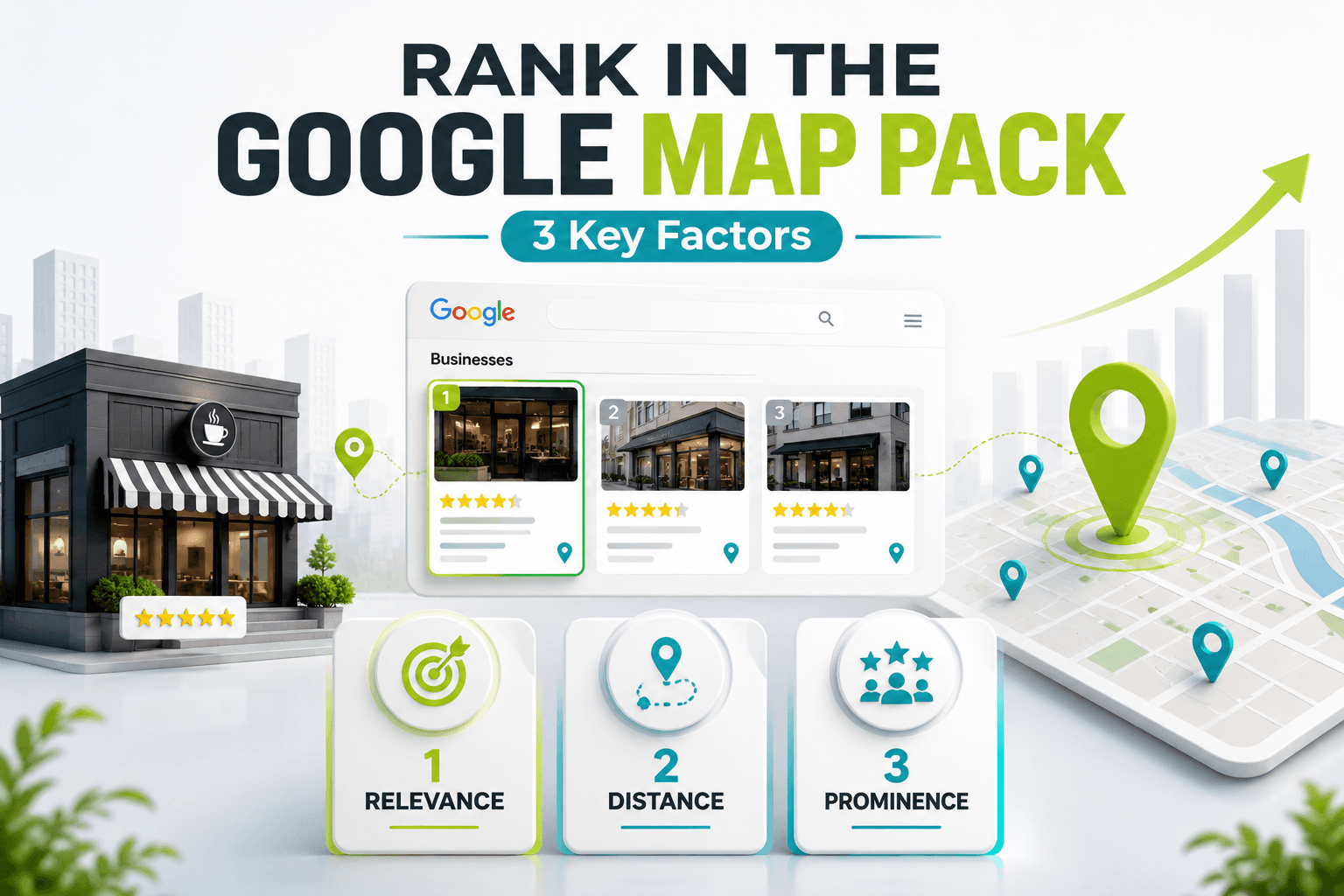
The Google map pack is the block of three local business listings that appears under the map on searches like "plumber near me" or "seo company carlsbad". Google explains in its own documentation that local results are ranked by three factors: relevance, distance, and prominence. Relevance is how well your listing matches what the searcher asked for. Distance is how far your business is from the searcher. Prominence is how well known and well reviewed your business appears to be, online and offline.
Here is the honest version of what that means for a local business: you can directly control relevance, you can only partially work around distance, and you can build prominence steadily over time. This guide walks through all three, what actually moves each one, and the realistic timeline, so you can spend effort where it counts instead of chasing tricks.
What is the Google map pack?
The map pack (Google also calls it the local pack) is the group of three business listings shown with a map near the top of results for searches with local intent. It appears above the regular organic results on most of those searches, which is why it gets such a large share of clicks and calls.
Each listing in the pack shows the business name, star rating and review count, category, and often hours, photos, and a phone link. The data comes from your Google Business Profile, not from your website. Your website still matters, but the map pack is fundamentally a competition between profiles.
- Searches like "service + city" or "service near me" trigger it
- It ranks separately from regular organic results: a site on page one of organic can be absent from the pack, and vice versa
- Clicking "More places" reveals the full ranked list behind the top three
- On mobile, the pack often fills the entire first screen
What are the three factors Google uses?
THE THREE MAP PACK FACTORS
- Relevance: does your profile match the search?FULLY IN YOUR CONTROL
- Distance: how close are you to the searcher?LIMITED CONTROL
- Prominence: how established do you look?BUILDS OVER TIME
GOOGLE NAMES ALL THREE IN ITS OWN DOCUMENTATION
These three factors work together, and a strong showing in one can make up for a weaker showing in another. Google gives the example that a business farther away can outrank a closer one when Google decides it is more likely to have what the searcher wants. That is worth sitting with, because it means distance is not destiny.
It also means there is no single lever. Businesses that dominate the map pack in competitive categories are usually strong on all three at once: a complete, accurate profile, a sensible location or service area, and a steady stream of reviews and activity. The rest of this guide takes the factors one at a time.
Relevance
Relevance is how well your Google Business Profile matches the words and intent of the search. Google reads your categories, your services, your business description, your reviews, and the website your profile links to, then decides whether you are a good answer for "emergency electrician" or "wedding cake bakery".
Distance
Distance is measured from the searcher's location, or from the place named in the search, to your business location or service area. It is the factor people blame most and can influence least. Two identical businesses will see different map packs from opposite ends of the same city.
Prominence
Prominence is Google's confidence that your business is real, established, and liked. It draws on your review count and quality, how consistently your business appears across the web, links to your site, and your overall search presence. Prominence is the slowest factor to build and the hardest for competitors to copy.
How do you improve relevance?
Relevance work is mostly profile work, and most businesses have never done it thoroughly. The goal is simple: when Google reads your profile, it should be obvious exactly what you do, where you do it, and for whom.
- Set the right primary category. It carries more weight than any other profile field, so pick the most specific one that fits, "Marketing agency" beats "Consultant", "Birria restaurant" beats "Restaurant".
- Add every secondary category that genuinely applies, and no more than that.
- Fill in the services section with the actual services people search for, using plain language.
- Write a description that says what you do and which areas you serve, without keyword stuffing.
- Link the profile to a page that matches it: a local service page beats a generic homepage.
- Keep hours, phone, and attributes complete and current. Incomplete profiles lose to complete ones.
Your website deepens relevance too. A dedicated page for each service and each city you serve gives Google text to connect your profile to, and structured data helps it read that text with confidence. We covered that side in our plain-English guide to schema markup for small business websites, and it is part of every local SEO plan we run.
Can you overcome the distance factor?
Partially, and it is better to be honest about the limits than to promise a workaround. Google uses the searcher's location, and you cannot change where your customers stand when they search. What you can do is make sure distance is measured fairly and offset it with the other two factors.
- Service-area businesses: set your service area accurately so Google knows which searches you belong in, even with a hidden address
- Storefronts: make sure your map pin is exactly right, wrong pins quietly cost rankings and customers
- Build city pages on your website for the areas you serve, so relevance signals extend beyond your immediate neighborhood
- Accept that the map pack a few towns over may be out of reach, and let your website's organic rankings compete there instead
This is also why prominence matters so much: Google's documentation is explicit that strong relevance and prominence can beat a shorter distance. The businesses that show up across a whole metro area are the ones that earned it with reviews and reputation, not the ones with a clever pin location.
How do you build prominence?
Prominence is where the compounding happens, and reviews are its engine. Count matters, but so do recency, star rating, the words reviewers use, and whether the business responds. A profile with fresh reviews every month signals a business that is alive and busy.
REVIEW HABITS THAT BUILD PROMINENCE
- Ask every happy customer, every timeA steady trickle beats one big burst
- Respond to every review, good and badResponses are a visible trust signal
- Keep name, address, and phone identical everywhereDirectories, site, and profile must agree
- Buy reviews or trade incentives for themAgainst guidelines and grounds for suspension
- Stuff keywords into your business nameWorks briefly, then gets reported or removed
- Let photos and posts go stale for monthsA silent profile reads as a closed business
Beyond reviews, prominence draws on your wider footprint. Consistent listings on the directories that matter for your industry, mentions and links from local sites, and an active profile with regular posts and photos all add up. None of these is dramatic on its own. Together they are the difference between a profile Google trusts and one it hesitates on.
One thing we tell every client: prominence work is never wasted, because the same reviews and reputation that move the map pack also show up in AI answers and directory rankings. It is the rare SEO investment that pays in three places at once.
How long does it take to rank in the map pack?
It depends on your market and your starting point, but the shape of the work is consistent. Here is the sequence we follow in the accounts we manage.
A REALISTIC MAP PACK TIMELINE
- Fix the foundationWEEKS 1 TO 2
- Start the review engineMONTH 1
- Deepen relevanceMONTHS 1 TO 3
- Let prominence compoundMONTHS 3 TO 6
Some fixes show up fast. A corrected primary category or a repaired pin can move rankings within weeks. Prominence is slower, which is exactly why it defends you once you have it: a competitor cannot copy two years of reviews in a month.
Be wary of anyone selling guaranteed map pack placement on a short deadline. Google publishes no such lever, and the tactics that fake it, review bursts and keyword-stuffed names, are the same ones that get profiles suspended.
Your map pack plan, starting this week
The map pack is decided by relevance, distance, and prominence. You control relevance directly through a complete and specific profile backed by real service pages. You manage distance by setting your service area honestly and extending your reach with city pages. You earn prominence with steady reviews, responses, and consistent listings, and it compounds the longer you keep at it.
- Open your Google Business Profile and check the primary category. Be as specific as the list allows.
- Fill in every service you offer, in the words customers use.
- Ask your three most recent happy customers for a review, and reply to the last five reviews you received.
- Search your business name, address, and phone across the web and fix any listing that disagrees.
- Check that your profile links to a page that actually matches what you sell in that city.
That list is a real week of progress, and none of it requires an agency. If you would rather have the whole system handled, the profile work, the review engine, the city pages, and the tracking to prove it is working, that is exactly what our local SEO plans do, and local SEO is included in every SEO plan we offer. The easiest first step is a free strategy call, where we show you where you stand before you spend a dollar.