Speed to Lead: Why Responding Fast Wins Deals
Learn why responding to leads within 5 minutes dramatically improves conversion rates, and how to build a speed-to-lead process that actually works.
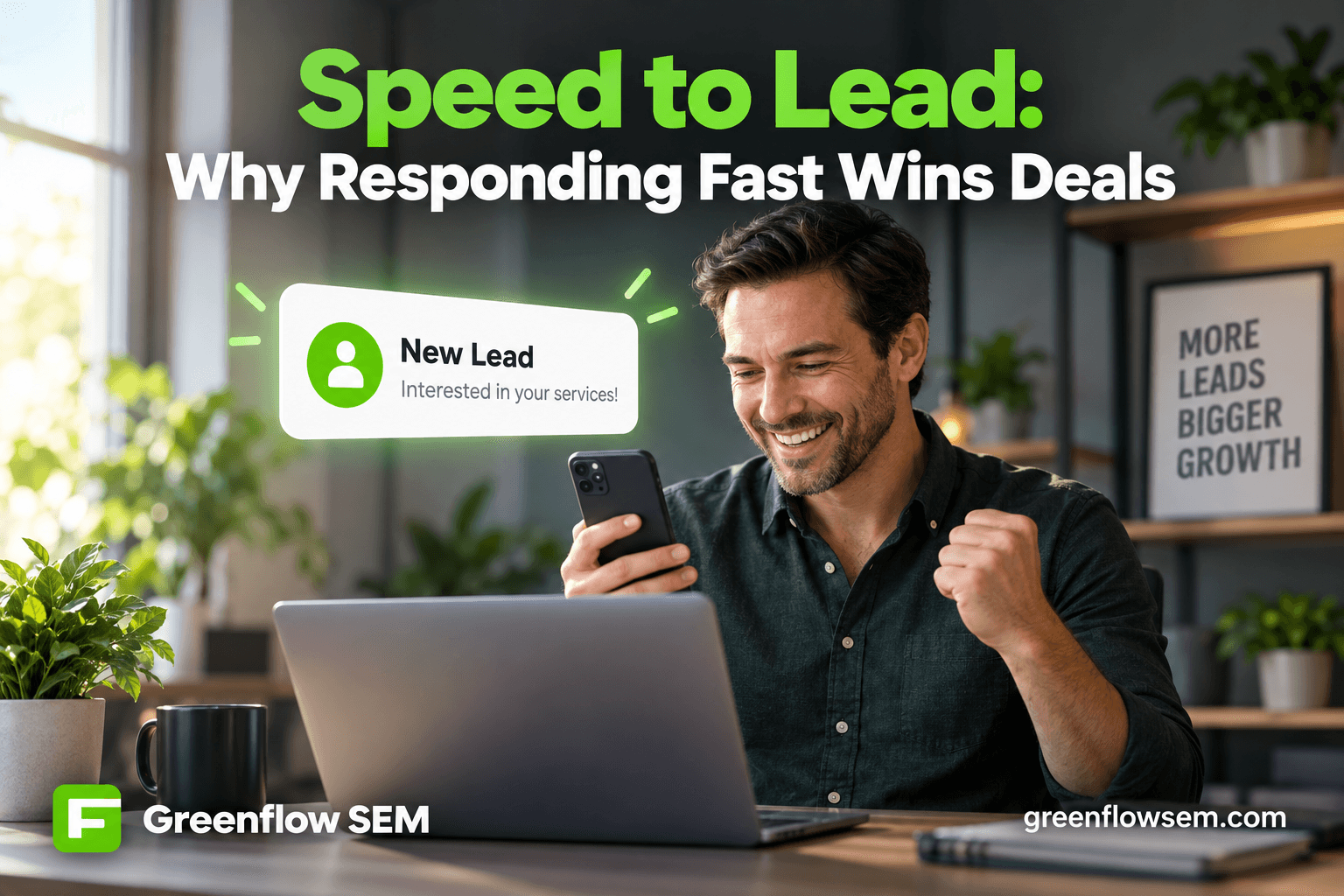
Speed to lead wins because buyers who fill out a form or call your business are comparing you to competitors in real time. The business that responds first usually gets the job, the appointment, or the sale, simply because the prospect stops looking once someone answers. Responding within 5 minutes, instead of waiting hours, is one of the highest-leverage changes a small business can make to its marketing without spending another dollar on ads.
This matters just as much as the campaigns that generate the lead in the first place. You can run flawless Google Ads or rank number one in local search, but if a lead sits in an inbox for three hours, the money spent to generate it is largely wasted. This post explains why speed matters, what the data and field experience consistently show, and how to build a response system that doesn't depend on someone being glued to their phone.
Why Does Responding Fast Matter So Much?
When someone submits a form on your website, calls your Google Business Profile number, or messages you on social media, they are almost never contacting only you. In the accounts we manage, we see prospects for services like home repair, legal consultations, and auto repair regularly fill out three or four competing quote requests within the same few minutes.
The first business to call back frequently sets the frame for the entire decision. A fast response signals professionalism and reliability before a single word is said about price or service quality. A slow response signals the opposite, even if your work is better and your pricing is fairer.
There's also a psychological factor at play. Buying intent peaks at the moment someone hits submit. Every minute that passes after that, their urgency fades, distractions pile up, and the odds they answer your callback or reply to your email keep dropping.
What Counts as a Lead Worth Responding To Fast
- Website contact form submissions
- Phone calls, especially missed calls that go to voicemail
- Google Business Profile messages and call tracking numbers
- Chat widget conversations
- Quote requests from Local Services Ads
- Social media DMs and comments asking about pricing or availability
How Much Does Response Time Actually Affect Conversions?
Well-established research on lead response time, including widely cited studies from Harvard Business Review and InsideSales.com, has found that contacting a lead within the first five minutes produces dramatically higher qualification and contact rates than waiting even 30 minutes. The exact multiplier varies by industry and source, but the directional finding is consistent and has held up across more than a decade of sales research: faster is always better, and the drop-off after the first few minutes is steep, not gradual.
This pattern shows up constantly in home service, legal, auto, and local retail categories, where buyers are comparing multiple providers and have low switching costs. It matters less in long B2B sales cycles where a single response delay of an hour is unlikely to lose the deal, but for most small businesses running local ads, speed to lead is one of the most reliable levers available.
LEAD RESPONSE WINDOW
- 0-5 minutesHighest contact rate
- 5-30 minutesNoticeably lower
- 30-60 minutesInterest fading
- 1-24 hoursMostly gone cold
- 24+ hoursLead likely converted elsewhere
This isn't a linear decline. The steepest drop happens in the first hour, which is exactly why so many businesses lose winnable leads without realizing it. A lead that comes in during a busy afternoon and gets a callback the next morning has, in most cases, already hired someone else or moved on.
The practical takeaway is that your marketing budget and your response process are two halves of the same system. Spending more on ads without fixing response time is like filling a bucket that has a hole in the bottom.
What Happens When Leads Wait Too Long?
Slow response doesn't just lose the one lead that got away. It compounds over a campaign's lifetime in a few specific ways.
- Wasted ad spend: every lead that goes unanswered is a paid click or paid lead that produced no return
- Lower Local Services Ads performance: Google's algorithm favors providers who respond quickly and accept leads, so slow responders can see fewer leads over time
- Worse review volume: customers who never got a callback rarely leave a positive review, and some leave a negative one
- Skewed reporting: a campaign can look underperforming when the real problem is follow-up, not targeting or budget
- Sales team frustration: reps who only get stale leads close less often and lose confidence in the marketing
This is a recurring theme when we review Google Ads metrics with clients. A campaign with a healthy cost per lead can still look unprofitable if half the leads never get a timely reply. Fixing response time is often a faster win than adjusting bids or keywords.
How Do You Build a Speed-to-Lead System That Actually Works?
Fast response isn't about asking your staff to check email more often. It requires a system that removes the dependency on any one person being available at the exact moment a lead comes in.
The Core Building Blocks
- Instant notification: every new lead triggers a text or push alert the moment it arrives, not a daily digest email
- A clear owner: one person or a rotating on-call assignment is always responsible for the next incoming lead
- A script or checklist: the first call shouldn't require improvising; a short script keeps the response fast and consistent
- A fallback for after-hours leads: a chatbot, auto-text, or answering service keeps the clock from running out overnight
- Tracking: log the time a lead arrived and the time it was first contacted so you can measure your own performance
FROM LEAD TO CONTACT
- Form submittedTriggers alert
- Text/call alert sentWithin seconds
- Staff or AI respondsUnder 5 minutes
- Lead qualifiedLogged in CRM
- Follow-up scheduledIf not reached
Most businesses already have three or four of these pieces in some form. The gap is usually the first one: notification speed. A form that emails a shared inbox nobody checks until end of day is functionally the same as having no form at all.
This is also where automation earns its keep. Tools that text a new lead immediately, or an AI chat assistant that answers questions and books an appointment the moment someone lands on your site at 9pm, close the exact gap that costs businesses the most leads. We cover this in more detail in our guide to AI chatbots for small business.
What Should the First Response Actually Say?
Speed matters, but the first message still has to do its job. A fast reply that's sloppy or overly salesy can undo some of the advantage of getting there first.
FIRST RESPONSE: DO / DON'T
- Call within 5 minutesEven a quick voicemail helps
- Wait for a 'better time' to callThe lead won't wait
- Confirm the specific requestShows you read the form
- Send a generic auto-reply onlyFeels like no one's home
- Offer a clear next stepBook a call or quote
- Ask them to call you backPuts the burden on them
A good first response acknowledges exactly what the person asked for, whether that's a quote, an appointment, or a question about availability. It should also give them one easy next step instead of a list of options. If a call isn't possible immediately, a text that says you're reviewing their request and will call within the hour still beats silence.
For businesses running Local Services Ads, fast and specific responses also matter for the platform itself. Google's Local Services Ads program tracks how quickly providers respond and factors that into how often they're shown, which is one more reason speed to lead affects both conversion and visibility. We go deeper on how LSA pricing and lead delivery work in our Local Services Ads pricing guide.
Does This Apply to Every Type of Business?
Speed to lead matters most in categories where buyers compare multiple providers quickly and have an urgent need: home services, auto repair, legal consultations, medical and dental, restaurants taking catering inquiries, and contractors bidding on jobs. It matters less in categories with long consideration cycles, like enterprise software or commercial real estate, where a same-day response is usually fast enough.
In the accounts we manage, local service businesses and restaurants see the clearest impact. A concrete contractor or auto body shop competing for a same-day estimate loses the job to whoever calls back first far more often than to whoever has the lowest price. This is one reason website and ad quality alone don't guarantee results. A contractor website that generates calls still needs a fast, well-staffed phone line behind it to convert.
How Do You Measure Whether Your Speed to Lead Is Actually Working?
You don't need complicated software to start tracking this. A simple spreadsheet or a field in your CRM that logs the lead's arrival time and the first contact time is enough to start seeing patterns.
- Track median response time across all leads, not just the fast ones, so outliers don't hide a real problem
- Separate response time by source (ads, organic, referral) to see if one channel is underperforming on follow-up
- Compare conversion rate for leads contacted under 5 minutes versus over an hour
- Review after-hours and weekend leads separately, since these often get the slowest response
- Revisit the data monthly alongside your ad and SEO performance reviews
This kind of tracking pairs naturally with conversion tracking in Google Ads. Once you know which leads converted and how quickly they were contacted, you can see exactly how much revenue slow response time is costing, not just estimate it.
Key Takeaways and Next Steps
Speed to lead wins because the first business to respond usually controls the sale, not the business with the lowest price or the flashiest ad. Response time within 5 minutes produces measurably better contact and conversion rates than waiting even 30 minutes, and that gap only widens from there. The fix isn't working harder, it's building a system: instant alerts, a clear owner for every lead, a simple script, and an after-hours fallback so no lead sits untouched overnight.
This week, you can take a few concrete steps without any new software or spend:
- Pull your last 20 leads and check how long it took to make first contact with each one
- Set up a text or push alert for new form submissions if you don't already have one
- Write a two-sentence script for the first callback so response doesn't depend on improvising
- Decide who owns after-hours leads, even if it's just an auto-text promising a morning callback
- Set a goal of contacting every new lead within 5 minutes during business hours and track it for two weeks
If you'd rather have this built and running instead of managing it manually, our AI Automation service sets up instant lead alerts, AI chat responses, and follow-up workflows so no lead waits on a human to be free. And if you want a second look at whether your ad spend is actually converting once it reaches your team, a free Google Ads audit is a good place to start that conversation.