Social Ads vs. Google Ads for Local Business
Compare Google Ads and social media ads for local businesses: costs, intent, best use cases, and how to decide which platform to run first.
Social Media Ads vs. Google Ads: The Short Answer
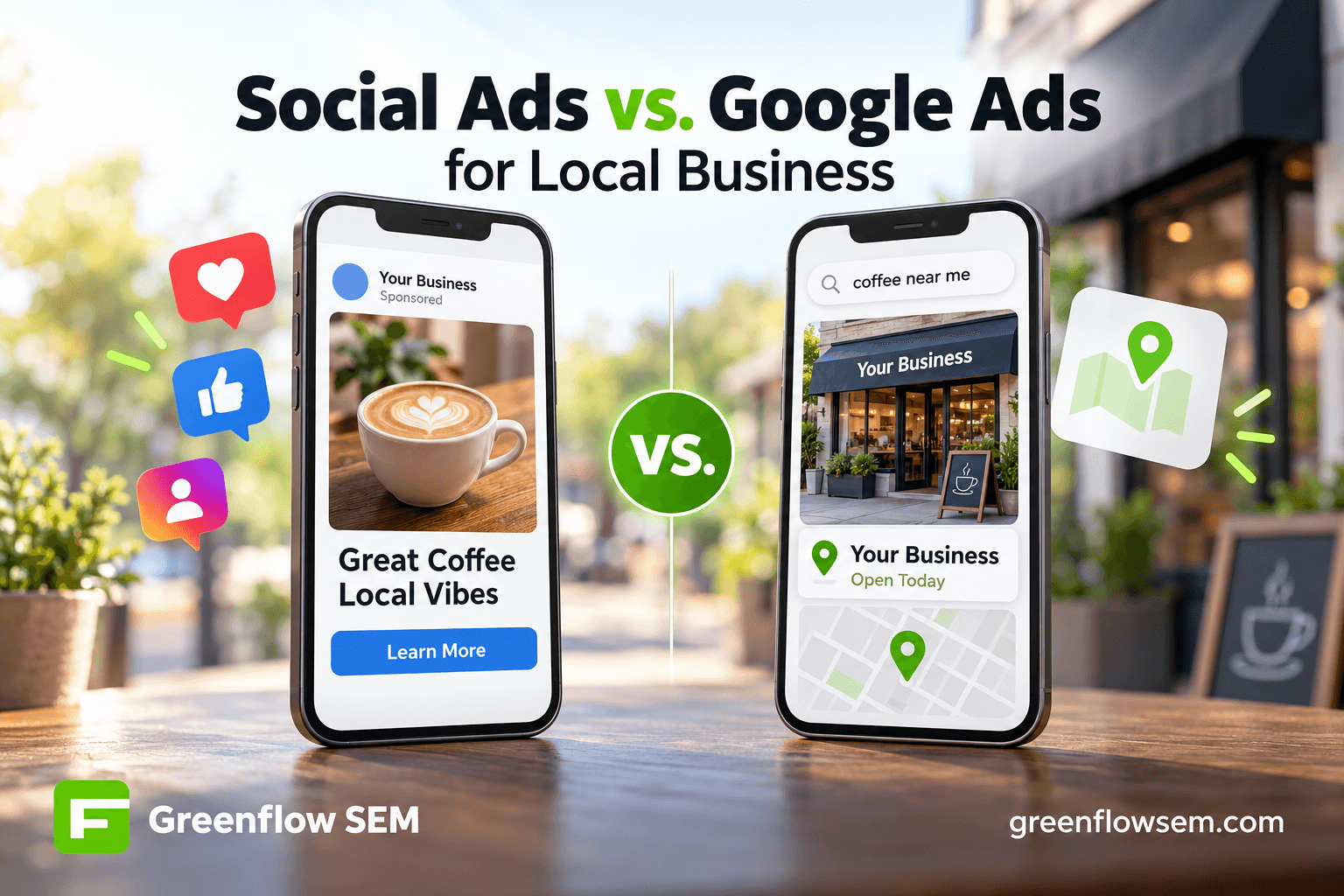
For most local businesses, Google Ads is the better first move. It puts your business in front of people who are actively searching for what you sell, right when they're ready to call or book. Social media ads do something different: they put your business in front of people who aren't searching yet but match the profile of your ideal customer.
Neither platform is universally better. The right choice depends on how your customers shop, how fast you need leads, and what you can spend each month. This guide breaks down how each platform works, what they cost, which businesses should start with which, and when running both makes sense.
How Google Ads Works for Local Business
Google Ads shows your business at the top of search results when someone types a relevant query into Google. A plumber running ads might show up for 'emergency plumber San Diego.' A roofer might show up for 'roof repair near me.' The person searching already has a problem and is looking for a solution, which is why search ads tend to convert well for local service businesses.
- High commercial intent: people are already looking to buy or book
- Pay-per-click pricing, so you only pay when someone clicks
- Works alongside Local Services Ads, which charge per lead instead of per click
- Requires ongoing management, including negative keywords and conversion tracking, to stay efficient
Local Services Ads: A Pay-Per-Lead Alternative
Local Services Ads sit above standard Google Ads results and show a Google Guaranteed badge for eligible categories like plumbing, HVAC, and legal services. Instead of paying per click, you pay per qualified lead. Management runs $500 per month flat, separate from the lead budget paid directly to Google. We cover this in more detail in our Local Services Ads pricing guide and in Google Ads vs. Local Services Ads: Which Should You Run First?
How Social Media Ads Work for Local Business
Social media ads run on platforms like Facebook and Instagram. Instead of targeting a search query, they target a person, based on location, age, interests, behaviors, or past interaction with your business. Nobody typed 'birria restaurant near me' before seeing an ad for one; the ad introduced them to the idea.
- Built for visual products and services: food, retail, home transformations, events
- Strong for building a following and staying visible between purchases
- Lower intent than search, so pricing is often measured in cost per lead rather than cost per click alone
- Works well for building remarketing audiences that Google Ads can later target
In the accounts we manage, social ads tend to perform best for businesses with something to show: a restaurant's food, a contractor's finished project, a retail product in use. SD Food Truck Pros, a food truck manufacturer, generated 5,437 social leads at $7.54 each and 15,545 landing page views at $0.26 each by pairing social ads with a conversion-focused site. Mr. Birria picked up 14,759 new followers and 4,825 catering leads at $7.24 each using the same approach.
GOOGLE ADS VS. SOCIAL ADS
- Google AdsCaptures active search demandFrom $700/mo
- Local Services AdsPay per qualified lead$500/mo flatLead budget separate
- Social Media AdsBuilds awareness and demandFrom $750/mo
These figures are management fees, not total ad spend. Google Ads and social ads both require a separate media budget paid to the platform, on top of the management cost. Local Services Ads is the exception: you pay Google directly per lead, and that lead cost is never included in the $500 monthly flat management fee.
Cost alone shouldn't decide which platform you pick. A $700 per month Google Ads plan aimed at low-volume, high-intent searches, like 'commercial concrete contractor,' can out-earn a $750 per month social campaign chasing broad awareness, and vice versa for a business that depends on repeat visibility, like a restaurant. The deciding factor is how your customers actually search and decide, not which platform costs less upfront.
Which Businesses Should Start with Google Ads First?
Google Ads tends to work best when customers already know they have a problem and go looking for a solution. That's most true for service businesses people search for under pressure or with a specific need.
- Plumbers, electricians, and HVAC companies handling emergency and repair searches
- Roofers and contractors after storm damage
- Auto repair and auto body shops
- Lawyers and other licensed professionals
- Smog check stations and other pass/fail compliance services
Belcrete Concrete Services cut cost per click by more than 50% and lifted conversion rate from 0% to 20-30% with tightly targeted Google Ads search campaigns built around what customers were actively searching for. Magnolia Smog Check converted 40-45% of ad traffic and tripled customer volume the same way. Businesses like these rarely need to explain what they do; they need to be visible the moment someone searches for it. For more on budgeting correctly, see How Much Should a Small Business Spend on Google Ads in 2026?
Which Businesses Should Start with Social Media Ads First?
Social ads work best when the product is visual, impulse-driven, or needs to build a following over time rather than capture a one-time search.
- Restaurants, food trucks, and catering businesses
- Med spas, salons, and aesthetics practices
- Retail and boutique shops
- Event-based businesses, like pop-ups and grand openings
- Businesses that depend on repeat visits and brand recall
Mr. Birria built a viral social presence before layering in Google Ads, generating over 47,000 Google Ads actions and 10,800+ store visits once search demand caught up with brand awareness. We go deeper on this playbook in Facebook Ads for Restaurants: A Practical Playbook.
WHICH CHANNEL FIRST
- Emergency plumberGoogle Ads first
- New restaurantSocial ads first
- Roofer after stormGoogle Ads first
- Food truck launchSocial ads first
- Med spa openingBoth, social leads
- Auto body shopGoogle Ads first
$7.54
Avg. social lead cost
$0.26
Landing page view cost
The pattern holds across most local categories. If the purchase is reactive, something breaks, something is due, something is urgent, search intent already exists and Google Ads captures it efficiently. If the purchase is discretionary or emotional, like where to eat or where to get pampered, social ads do the work of creating the interest first.
This isn't a permanent split. A roofer can use social ads to build trust and showcase finished jobs over time. A restaurant can run Google Ads once enough people start searching for it by name. The 'first' channel is about where the budget does the most immediate work, not where it has to stay forever.
Can You Run Both at the Same Time?
Yes, and in many of the accounts we manage, running both is what produces the strongest overall numbers. The two channels reinforce each other instead of competing.
- Social ads introduce the brand to people who haven't searched for it yet
- Google Ads captures the demand once those people, and others, start searching
- Retargeting audiences built from social traffic can be layered into Google's display and remarketing campaigns
- A consistent visual brand across both platforms makes each ad perform better by building recognition
The practical question is budget sequencing, not platform exclusivity. Most businesses with a limited monthly marketing budget get more value from mastering one channel before splitting spend across two. We walk through how to set that budget in How to Set a Small Business Marketing Budget.
Common Mistakes When Choosing Between the Two
DO THIS, NOT THAT
- Match the channel to buyer intent
- Running identical ads on both platforms
- Track conversions on both channels
- Judging social ads by cost-per-click alone
- Giving each channel at least 60-90 days
- Switching platforms before the data settles
Google Ads and social ads measure success differently. A search ad's cost per click looks expensive next to a social ad's cost per click, but the comparison is meaningless, because the person clicking a search ad is already looking to buy, while the person clicking a social ad is still deciding whether your business is relevant to them. Conversion tracking set up correctly on both platforms is what makes an honest comparison possible.
The second common mistake is giving up too early. Search campaigns typically need a few weeks of data before Quality Score and targeting stabilize. Social campaigns need time for the algorithm to find the right audience and for creative fatigue to show up in the data. Pulling the plug inside the first two to three weeks rarely gives either platform a fair test.
Key Takeaways and What to Do Next
Google Ads and social media ads solve different problems. Google Ads captures people who are already looking for what you offer. Social media ads create interest among people who aren't searching yet but fit your customer profile. Most local businesses are better served starting with whichever channel matches how their customers actually shop, then adding the second channel once the first is running efficiently.
- List your last 20 customers and note whether they found you by searching for your service or by seeing your business somewhere else first.
- If most found you through search, check your Google Business Profile and consider a small Google Ads test budget.
- If most found you through word of mouth or social media, build a simple social ad campaign showcasing your work or product.
- Set up basic conversion tracking before spending on either platform, so you can measure results honestly from day one.
If you'd rather have a professional look at your specific numbers before committing a budget, we offer a free Google Ads audit and can walk you through what a combined Google Ads and social ads plan would look like for your business. Book a call and we'll tell you honestly which channel fits your situation, even if that means recommending just one of the two for now.