Google Ads Quality Score: What It Is and How to Improve It
Learn what Google Ads Quality Score really measures, why it affects your cost per click, and the practical steps to raise it in your own campaigns.
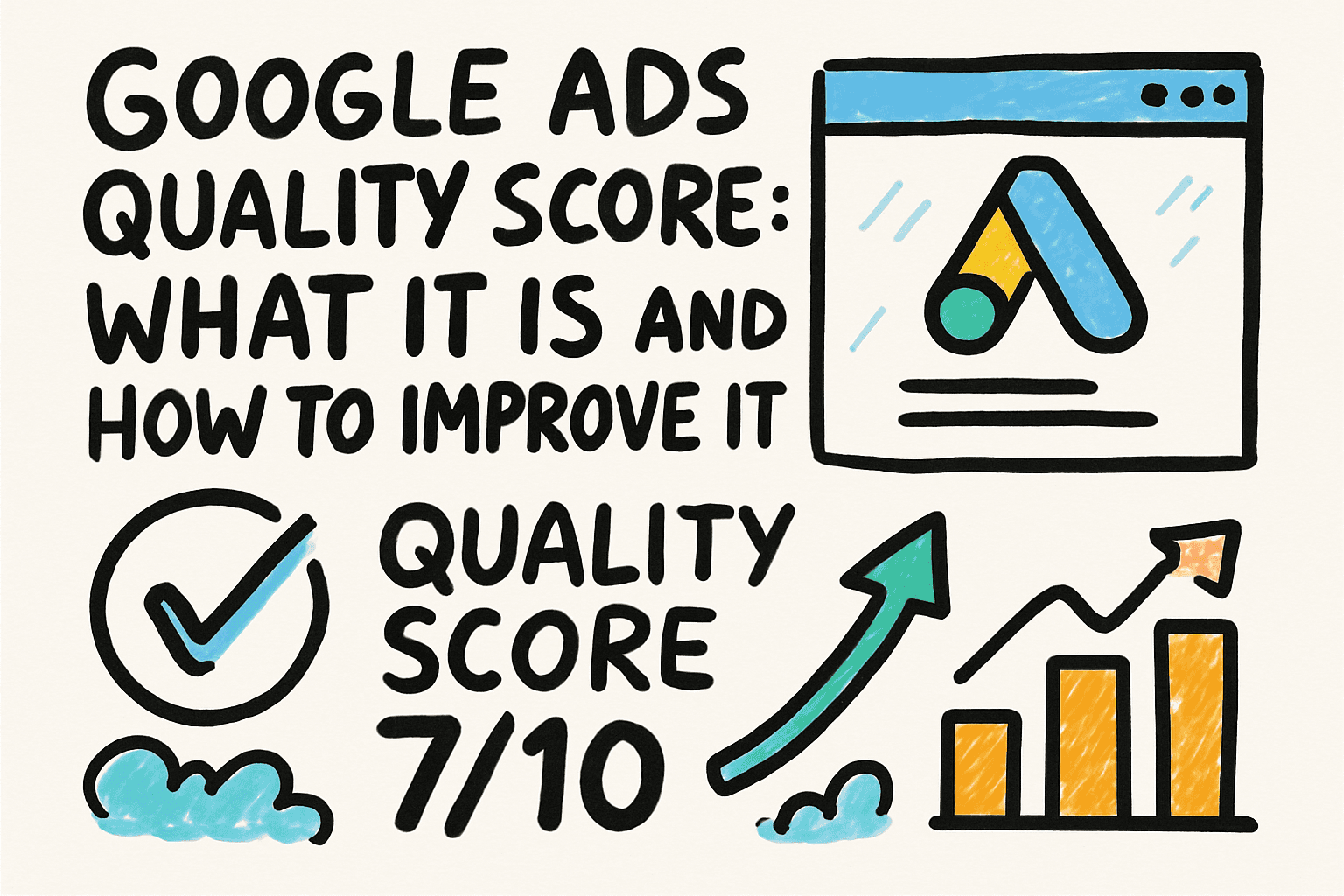
Google Ads Quality Score is a 1-to-10 rating Google assigns to each keyword in your account, based on how relevant and useful your ads and landing pages are to the people searching for that keyword. A higher score generally means you pay less per click and show up in better ad positions for the same bid, while a low score does the opposite.
You improve it by tightening the connection between your keywords, your ad copy, and your landing page, while also giving people a fast, mobile-friendly page that actually answers what they searched for. There is no shortcut around this. Quality Score rewards genuine relevance, not tricks.
What Is Google Ads Quality Score, Exactly?
Quality Score is a diagnostic tool, not a ranking factor you bid on directly. Google calculates it at the keyword level and displays it on a scale of 1 to 10 inside the Ads platform. It exists because Google's auction rewards ads that are useful to searchers, not just the highest bidder.
Two advertisers can bid the exact same amount on the exact same keyword and end up in very different positions, paying very different prices per click, because their Quality Scores differ. Google has said publicly that Quality Score is an aggregate estimate of ad quality built from three components, which we cover below.
It's worth remembering that the number you see in the interface is a reporting tool. The real-time version Google uses in each individual auction is more granular and calculated fresh for every impression. The 1-10 score is a useful directional signal, not the literal number plugged into the auction.
What Factors Determine Your Quality Score?
Google breaks Quality Score into three components, each rated as Below Average, Average, or Above Average when you check the keyword status column.
Expected Click-Through Rate (CTR)
This estimates how likely your ad is to get clicked when it shows for that keyword, compared to other advertisers targeting the same term. It's based on historical performance and how well your ad copy matches search intent, not your raw CTR number in isolation.
Ad Relevance
This measures how closely your ad's message matches the intent behind the keyword. If someone searches "emergency plumber San Diego" and your ad talks generically about "plumbing services," Google sees a mismatch even if the ad is technically related.
Landing Page Experience
This looks at whether the page someone lands on after clicking is relevant, transparent, easy to navigate, and reasonably fast. A page that makes visitors hunt for the thing they searched for, or that loads slowly on mobile, drags this component down.
QUALITY SCORE COMPONENTS
3
Core components
1-10
Score range shown
ALL THREE FEED THE SAME NUMBER, BUT EACH IS DIAGNOSED SEPARATELY
This breakdown matters because it tells you where to focus. An account with strong Ad Relevance but Below Average Landing Page Experience has a very different fix than one with weak Expected CTR. Checking all three individually, rather than only glancing at the overall 1-10 number, is what actually points you toward the right correction.
In practice, the three components tend to move together. Ads written for the exact intent of a keyword usually earn higher CTR, and a landing page built to match that same intent usually keeps people engaged rather than bouncing back to the search results. Fixing one often lifts the others.
Why Does Quality Score Actually Matter?
Quality Score is not a vanity metric. It has a direct, compounding effect on your cost per click and your ad position.
- Higher Quality Score keywords generally cost less per click for the same ad position
- Low Quality Score keywords can be priced out of competitive positions even with strong bids
- A 1-2 point improvement across a campaign can meaningfully shift your effective cost per click over time
- Poor landing page experience can suppress ad delivery even when your bid is competitive
- Quality Score problems tend to compound: low scores raise costs, which reduces the budget available for testing and refinement
For a business trying to figure out how far a given monthly budget will go, Quality Score is one of the biggest hidden variables. Two businesses with identical budgets can get very different volumes of clicks and conversions depending on how tightly their accounts are structured. We cover budget planning in more depth in how much a small business should spend on Google Ads in 2026.
How Do You Check Your Quality Score?
Quality Score lives at the keyword level inside Google Ads, not at the campaign or account level. To see it:
- Open the Keywords page for a campaign or ad group
- Click the columns icon and add "Quality Score," along with the three status columns for Expected CTR, Ad Relevance, and Landing Page Experience
- Review each keyword's score and its three underlying statuses
- Sort by Quality Score to quickly find your weakest keywords
- Cross-reference low scores against spend, so you prioritize fixing keywords that are actually costing you money
A keyword with a low score and almost no spend is not urgent. A keyword with a low score and heavy spend is where your improvement effort will pay off fastest.
How to Improve Your Quality Score
Every genuine Quality Score improvement comes down to tightening the match between three things: what someone searched, what your ad says, and what they see when they land. The tighter that alignment, the higher your score tends to climb.
Build Tighter Ad Groups
Broad ad groups stuffed with dozens of loosely related keywords make it impossible to write ad copy that feels specific to any one of them. Grouping keywords into small, tightly themed clusters, sometimes as few as five to fifteen closely related terms per ad group, lets you write copy that speaks directly to each group's intent.
Write Ad Copy That Mirrors Search Intent
Include the core keyword theme in your headlines. Address the specific need behind the search rather than a general version of your business. An ad for "same-day car AC repair" should read differently than an ad for "auto body paint estimates," even if both keywords technically belong to the same business.
Match the Landing Page to the Keyword
Sending every ad to your homepage is one of the most common Quality Score mistakes we see. A search for "driveway concrete estimate" should land on a page about driveway concrete work, not a general services page the visitor has to dig through.
KEYWORD-TO-PAGE ALIGNMENT
- "emergency plumber [city]"DEDICATED EMERGENCY SERVICE PAGE
- "driveway concrete estimate"DRIVEWAY-SPECIFIC LANDING PAGE
- "smog check near me"LOCATION AND PRICING PAGE
- "catering birria san diego"CATERING-SPECIFIC PAGE, NOT HOMEPAGE
EACH KEYWORD THEME EARNS ITS OWN DESTINATION
This mapping exercise sounds simple, but most accounts we take over from other agencies or from in-house management have never done it. Every ad group points to the same homepage or a generic contact page. Building even two or three dedicated landing pages around your highest-volume keyword themes is usually the single highest-leverage fix available.
It also pays off beyond Quality Score. A page built around a specific service or product tends to convert better because visitors immediately see that they're in the right place. If your current site can't easily support new landing pages, that's a sign worth addressing separately, and our guide on why slow websites lose leads covers the technical side of landing page performance.
Improve Landing Page Speed and Usability
Google's Landing Page Experience assessment considers load time, mobile usability, and how transparent the page is about what your business offers. A page that takes several seconds to load on mobile, or that buries your phone number and contact form below the fold, works against you here even if the content is otherwise relevant.
Use Negative Keywords to Protect Relevance
Irrelevant searches triggering your ads drag down Expected CTR because people click less often, or click and immediately leave. Regularly reviewing your search terms report and adding negative keywords keeps your ads showing only for searches you can genuinely serve.
Test Ad Copy Continuously
Running multiple headline and description variations within each ad group, and letting Google's optimization favor the stronger performers, gradually lifts your Expected CTR and Ad Relevance over time. This is an ongoing process, not a one-time setup task.
How Does Quality Score Connect to Overall Account Performance?
Quality Score is one lever in a larger system that includes budget, bidding strategy, keyword match types, and audience targeting. Raising Quality Score lowers cost per click, which stretches a fixed budget further, but it doesn't replace the need for a sound account structure or an accurate understanding of which channel fits your business first. If you're weighing paid search against other paid options, our comparison of Google Ads versus Local Services Ads is a useful next read.
In the accounts we manage, the businesses that see the strongest cost efficiency over time are the ones where ad group structure, landing pages, and negative keyword lists all get regular attention, not just the initial campaign build. Belcrete Concrete Services is one example: tightly targeted search campaigns brought cost per click down by more than 50% while conversion rate climbed from 0% into the 20-30% range. You can read the full Belcrete case study for the specifics.
Common Quality Score Mistakes to Avoid
- Sending all traffic to one homepage instead of intent-matched landing pages
- Building broad ad groups with dozens of unrelated keywords sharing the same ad copy
- Ignoring the search terms report and letting irrelevant queries trigger ads for months
- Chasing Quality Score as a goal in itself instead of a byproduct of genuine relevance
- Making one round of changes and never revisiting the account again
That last point deserves emphasis. Quality Score is not a setting you fix once. It shifts as competitors change their own ads, as your landing pages age, and as search behavior evolves. Accounts that get reviewed and refined on a regular cadence tend to hold higher scores than accounts left untouched after launch.
Frequently Asked Questions
Key Takeaways and Next Steps
Quality Score is Google's shorthand for how relevant your ads and landing pages are to the people searching for your keywords. It's built from three components: Expected CTR, Ad Relevance, and Landing Page Experience. Improving it means tightening ad groups, writing copy that mirrors search intent, matching landing pages to keyword themes, and maintaining the account with negative keywords and ongoing testing.
This week, you can check your own account's Quality Score by keyword, sort by spend to find where low scores are costing you the most, and look at whether your top keyword themes each have a dedicated landing page or are all pointing at the same generic page. Those two changes alone often move the needle.
If you'd rather have someone review the account structure, rewrite the ad copy, and build out matched landing pages for you, that's the kind of work we do daily inside Google Ads Management, with plans starting from $750 a month. You can also book a free strategy call to see exactly where your current account stands before deciding on anything.