Facebook Ads for Restaurants: A Practical Playbook
A practical guide to Facebook Ads for restaurants covering budgets, objectives, targeting, creative, and the metrics that actually predict more diners.
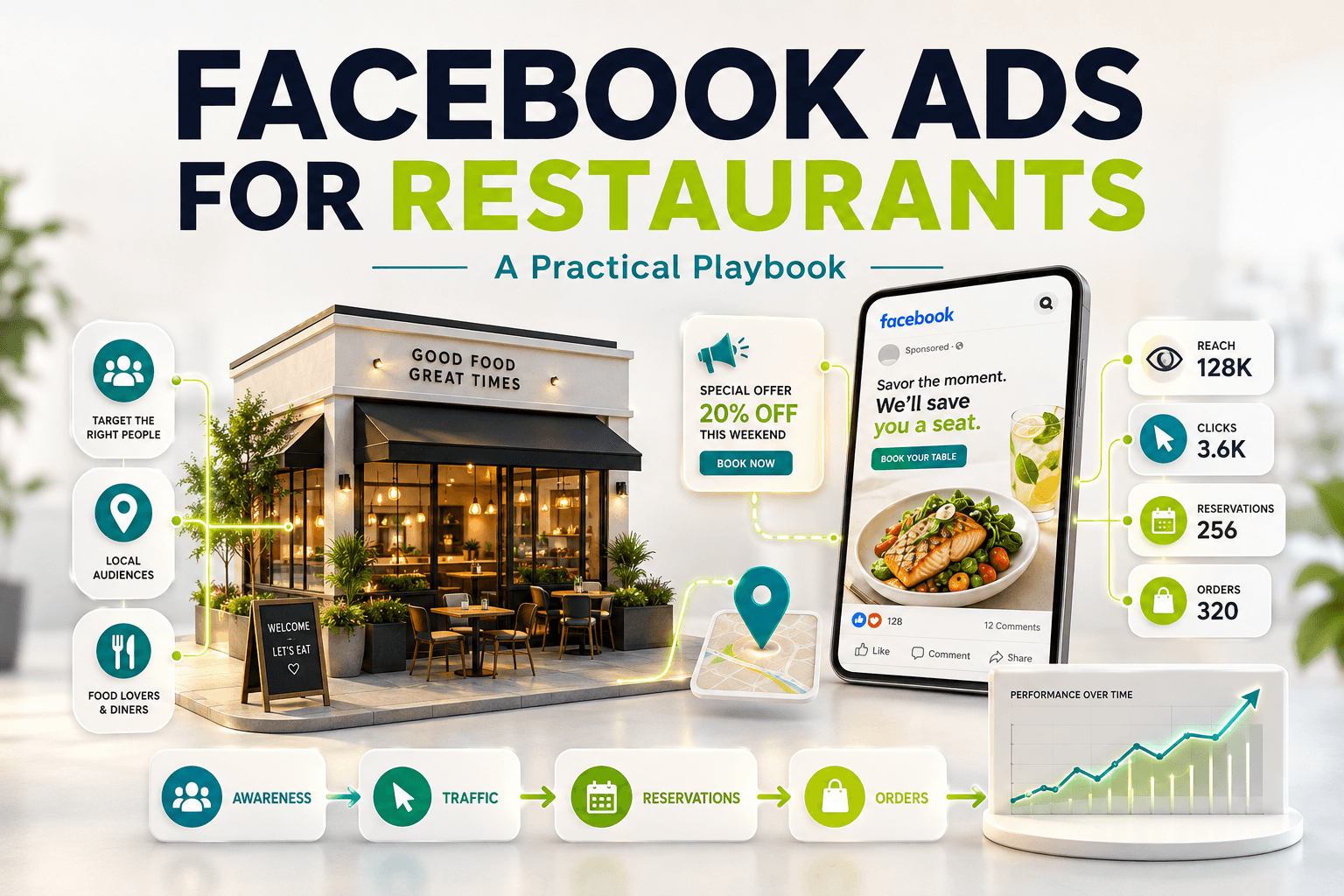
Facebook Ads work for restaurants when they combine tight local targeting, food-forward creative, and one clear next step: order now, book a table, or claim an offer. The platform's real strength for restaurants isn't broad brand awareness. It's proximity and visual appeal. Meta's ad system, which powers Facebook and Instagram placements together, can put a plate of food in front of someone a few miles from your door at the exact moment they're deciding what's for dinner.
This playbook covers budgeting, objectives, targeting, creative, and measurement for restaurant Facebook Ads, drawing on practices we use across the local businesses we manage. We'll also reference the Mr. Birria case study, a San Diego restaurant that paired paid social with Google Ads to drive thousands of catering leads and store visits.
Do Facebook Ads Actually Work for Restaurants?
Food is one of the most naturally visual products you can advertise, and that gives restaurants a real edge on Facebook and Instagram. Unlike a service business trying to explain what it does, a restaurant just has to show the food and let appetite do the persuading. People also make dining decisions on impulse far more often than they research a plumber or a lawyer, which means a well-timed, well-targeted ad can turn into a same-day visit or order.
The Mr. Birria case study shows what this looks like when paid social is paired with search advertising. That campaign generated 4,825 catering leads at $7.24 each, 23,069 landing page views at $0.24 each, and 14,759 new followers, alongside more than 1,600 phone leads and 10,800+ store visits driven by the combined effort. The lesson isn't that every restaurant will hit those exact numbers. It's that when a strong offer, sharp creative, and correct targeting line up, paid social can produce a steady, trackable stream of catering inquiries and foot traffic rather than vague "brand awareness."
Facebook Ads are less effective as a standalone tool for capturing people who are actively searching "restaurants near me" right now. That kind of high-intent demand is better served by search-based channels, which is why many restaurants run Google Ads alongside social. We cover how to sequence the two in the FAQ section below.
What Should Your Restaurant's Facebook Ad Budget Look Like?
Ad spend and management are two separate line items, and it helps to think about them that way from the start. Ad spend is what you pay Meta directly to serve impressions and clicks. Management is the strategy, audience building, testing, and ongoing optimization behind the campaign. Our Social Media Advertising management starts at $750/month on our Meta Ads plans, with ad spend paid directly to Meta on top of that.
There's no single correct budget for every restaurant, since it depends on your number of locations, how competitive your market is, and what you're promoting. Many restaurants start by testing a modest daily budget on one campaign, watch the cost per result for a couple of weeks, and then shift spend toward whichever offer or audience is producing the cheapest, best-quality outcome. The same discipline that applies to budgeting for Google Ads applies here: start small enough to learn, then scale what's actually working.
CAMPAIGN SETUP
- Define the GoalWEEK 1
- Build the AudienceWEEK 1
- Create the Offer & CreativeWEEK 2
- Launch & MonitorWEEKS 2-4
- Optimize & ScaleONGOING
This sequence matters because restaurants often skip straight to "launch and hope." Defining a single goal before touching the ads manager forces a decision about what success actually looks like, whether that's a catering form fill, a phone call, or a tracked online order. Skipping that step is how a restaurant ends up with an ad that gets plenty of likes but never moves a table.
The optimization phase is where most of the value gets created over time. Facebook's algorithm needs a data-gathering period before it can reliably find the right people, so resist the urge to change everything in the first week. Instead, let a campaign run long enough to gather meaningful data, then make one change at a time so you know what actually caused a result to improve.
Which Facebook Ad Objectives Make Sense for Restaurants?
Meta's ad platform optimizes delivery based on the objective you select, so choosing the wrong one wastes spend even if the creative is great. A campaign built for engagement will get you likes and comments, not necessarily people walking in the door.
OBJECTIVE MAP
- Store TrafficDrive walk-ins nearby
- EngagementBuild page audience
- LeadsCatering & event inquiries
- TrafficPush to online menu
- ConversionsOnline orders, reservations
$7.24
Cost per catering lead (Mr. Birria)
$0.24
Cost per landing page view (Mr. Birria)
Store Traffic uses location data to show ads to people near your restaurant and can help estimate incremental visits, which makes it a strong fit for a location that lives or dies on walk-ins. Leads is often the right choice for catering and private events, since it can collect an inquiry directly on the platform without requiring a fast-loading landing page.
Conversions is the objective for tracked online orders or reservation bookings, but it depends on a properly installed Meta Pixel and Conversions API on your website. Without accurate tracking, this objective has nothing reliable to optimize toward, which is the same reason we treat conversion tracking as foundational on the Google Ads side as well.
What Should You Actually Promote in Restaurant Ads?
A generic "come eat at our restaurant" ad rarely performs, because it gives someone no reason to act today instead of next month. Specific, time-bound offers consistently outperform general brand messaging in the accounts we manage.
- Limited-time menu items or seasonal specials
- Happy hour or off-peak discounts that fill slow hours
- Catering and private event packages
- Loyalty program or app sign-ups
- New location openings
- Reservation availability for holidays or date nights
Notice that most of these promote a specific decision rather than the restaurant in general. "20% off catering orders booked this month" gives someone a reason to act now. "Great Italian food" does not.
How Do You Target the Right Diners?
Facebook's targeting strength for restaurants comes from layering location, interest, and past-behavior signals rather than relying on any single one.
- Radius targeting around each location, typically tighter for walk-in traffic and wider for destination dining
- Interest and behavior targeting around cuisine type or dining habits
- Custom audiences uploaded from your email list or loyalty program
- Lookalike audiences modeled on your best existing customers
- Retargeting people who visited your website or viewed your menu
- Retargeting people who engaged with your Facebook or Instagram posts
Retargeting deserves special attention because it's usually the cheapest, highest-converting layer of a restaurant campaign. Someone who already looked at your menu online or watched most of a video of your food is far closer to ordering than a cold audience, and ads shown to that group generally cost less per result.
What Creative Actually Converts on Facebook and Instagram?
Food advertising lives or dies on appetite appeal, and that favors authenticity over polish.
CREATIVE CHECKLIST
- Short vertical video of foodBuilt for Reels and Stories
- Real photos from your kitchenNatural light beats staged shots
- One clear call to actionOrder, book, or claim the offer
- Stock photographyReads as generic, lowers trust
- Cluttered offer with fine printConfuses the ask
- Same static ad for monthsCreative fatigue sets in fast
Short vertical video tends to outperform static photos for restaurants because it fits naturally into Reels and Stories placements, where people are already scrolling through food content. It doesn't need to be highly produced. A steady shot of a dish being plated or a bite pulled apart often performs better than a polished commercial, because it looks like content rather than an ad.
Creative fatigue is a real, measurable problem on Meta's platforms. When the same ad runs to the same audience for too long, cost per result climbs even if nothing else changed. Plan to refresh creative every few weeks, and keep two or three variations running at once so you can retire the weakest one without pausing the whole campaign.
How Do You Measure Whether Facebook Ads Are Working?
The right metrics depend on the objective, but a few numbers matter across nearly every restaurant campaign.
- CPM (cost per thousand impressions), which reflects how competitive your audience and season are
- CTR (click-through rate), a quick signal of whether the creative and offer are relevant
- Cost per result, meaning cost per lead, order, or store visit depending on the objective
- ROAS (return on ad spend) for campaigns driving trackable online orders
Resist comparing your numbers to generic industry benchmarks you find online. Costs vary enormously by market, season, and offer, so the more useful comparison is your own account over time: is cost per result trending down as you refine targeting and creative, and does that cost make sense against what a customer is actually worth to you? For a broader grounding in how to read ad performance numbers, our guide to Google Ads metrics every business owner should know covers the same underlying logic that applies to paid social.
What Mistakes Do Restaurants Commonly Make With Facebook Ads?
- Sending ad traffic to a slow website or a PDF menu that takes forever to load, which quietly kills conversions (see why slow websites lose leads)
- Sending every click to the homepage instead of a page built around the specific offer (see landing pages vs. homepages)
- Running paid social while ignoring Google Business Profile optimization, which is often where diners check hours and reviews before visiting
- Cutting ad spend entirely during slower months instead of adjusting it, a mistake covered in seasonal Google Ads budgeting that applies just as well to social
- Running Facebook Ads with no presence in Google search, missing the high-intent searchers covered in Google Ads vs. Local Services Ads
Most of these mistakes come from treating Facebook Ads as an isolated channel rather than one part of a local marketing system. A diner who sees your ad, then finds an outdated Google Business Profile or a slow website, is unlikely to follow through no matter how good the ad creative was.
Key Takeaways and Your Next Steps
Facebook Ads can be a genuinely productive channel for restaurants when they're built around a specific offer, tight local and retargeting audiences, authentic food-forward creative, and an objective that matches the action you want. They work best paired with a fast website, an optimized Google Business Profile, and, in many cases, search advertising for people actively looking to eat right now.
- Audit your Facebook and Instagram pages: are your photos current, and does your menu link actually work?
- Confirm the Meta Pixel and Conversions API are installed correctly on your website so results can be measured accurately
- Pick one offer, one audience, and one objective, and build a single test campaign around it
- Run that campaign for two to three weeks before judging it, tracking cost per result rather than likes or reach
- Reallocate budget toward whichever creative or audience produces the lowest cost per result
If you'd rather have this built and managed for you, our Social Media Advertising work handles strategy, targeting, testing, and ongoing optimization, from $750 a month on our Meta Ads plans. Run it alongside Google Ads and, where your category qualifies, Local Services Ads, and you save 10% on both monthly fees while capturing both search-based demand and social-driven interest. You can see current plans on our pricing page or book a free strategy call to talk through what makes sense for your restaurant.