Landing Pages vs. Homepages: Why Sending Ads to Your Homepage Costs You Leads
Sending Google Ads or social ads to your homepage instead of a landing page quietly drains your budget. Here's what changes when you fix it.
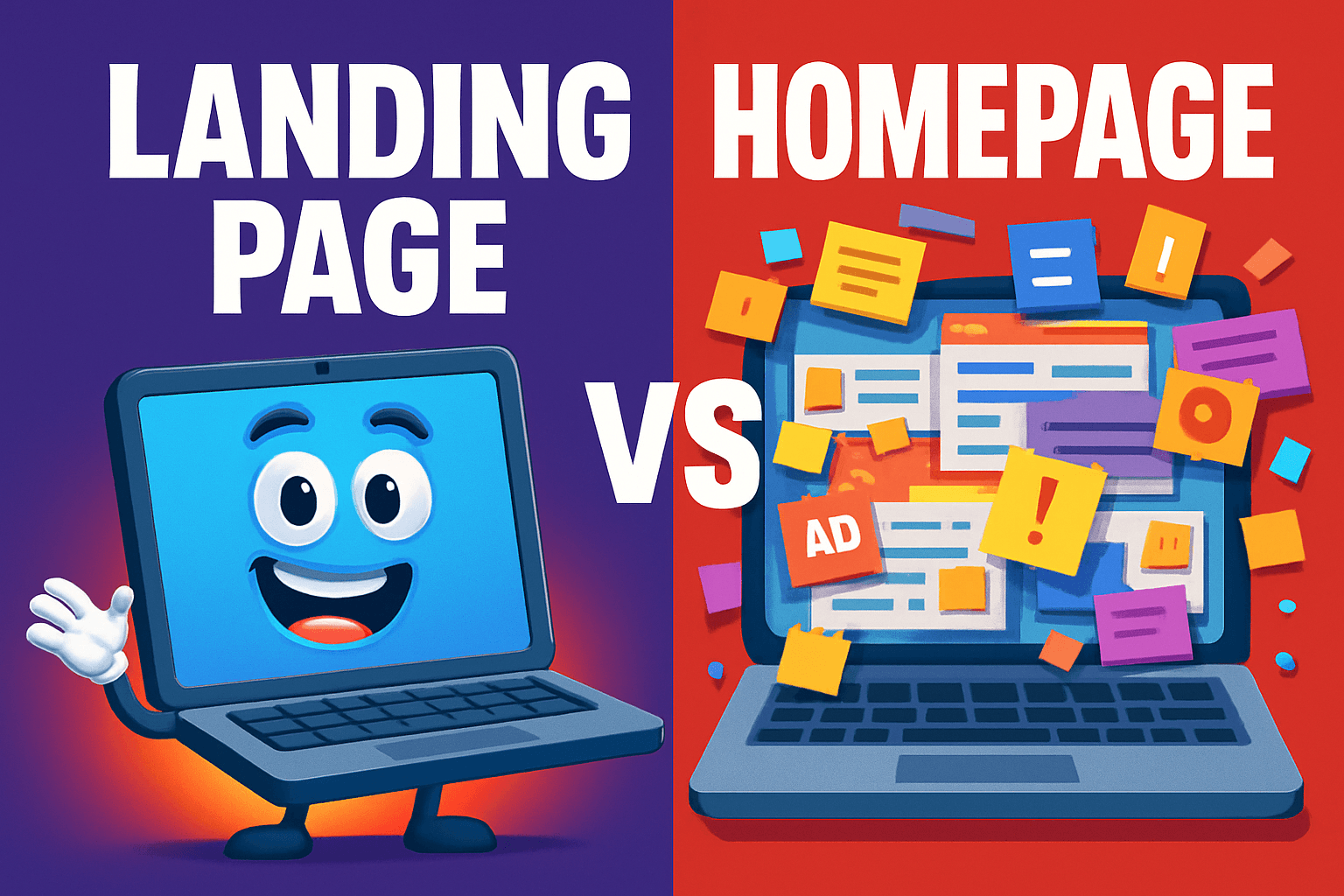
Sending ad traffic to your homepage costs you leads because a homepage is built to serve every visitor and every purpose at once, while an ad click represents one visitor with one specific intent. A landing page is built to answer that single intent immediately. When the two don't match, visitors hesitate, get distracted, or leave, and you pay for the click either way.
This mismatch is one of the most common and most fixable problems we see in the Google Ads and social ad accounts we manage. In this guide, we'll cover exactly what separates a landing page from a homepage, why the difference affects conversion rate and cost per lead, and how to build a landing page that turns more of your ad spend into actual customers.
What's the Difference Between a Landing Page and a Homepage?
A homepage is the front door to your entire business. It has to introduce who you are, list your services, link to your team, showcase your locations, and point visitors toward a dozen different pages depending on what they're looking for. That's the correct job for a homepage. Visitors who arrive there organically are often still exploring and haven't decided what they need yet.
A landing page has exactly one job. It exists to convert a specific type of visitor, arriving with a specific intent, into a lead or a customer. There's no main navigation to click away through, no unrelated service to get distracted by, and no scrolling through your company history before finding a phone number. Everything on the page supports one decision.
- Homepage goal: orient a broad range of visitors and guide them to the right section of the site.
- Landing page goal: convert one specific type of visitor who already knows why they clicked.
- Homepage audience: mixed intent, mixed stage of research, often browsing.
- Landing page audience: high intent, arriving from a specific ad with a specific promise.
- Homepage structure: many links, many possible next steps.
- Landing page structure: one message, one call to action.
Why Does Sending Ad Traffic to Your Homepage Cost You Leads?
When someone clicks a Google Ads or social ad, they've already made a small commitment. They searched for something specific, or a scroll-stopping post caught their attention, and they clicked expecting an immediate, relevant answer. A homepage rarely delivers that answer in the first three seconds, and three seconds is often all you get before a visitor decides to stay or bounce.
Homepages also introduce choice, and choice slows people down. A visitor who clicked an ad for "emergency water heater repair" doesn't want to land on a homepage that also promotes drain cleaning, remodeling services, and a blog. Every extra link is a chance for that visitor to wander off the path that was supposed to lead to a call or a form submission.
WHERE AD CLICKS ACTUALLY GO
- HomepageToo many distractions
- Blog postWrong intent match
- Contact page onlyNo context, cold ask
- Dedicated landing pageOne offer, one action
ONLY ONE OF THESE IS BUILT TO CONVERT AD TRAFFIC
This is also why Quality Score tends to suffer when ads point to a homepage. Google evaluates landing page experience as part of Quality Score, and a page that doesn't clearly relate to the ad's keyword or message can drag your score down, which raises your cost per click across the whole campaign. A weak landing page destination doesn't just lower conversion rate. It makes every click more expensive.
Page speed compounds the problem. Homepages tend to be heavier, with more images, scripts, and embedded content than a lean landing page. If your site is slow to load, a portion of your paid traffic leaves before the page even finishes rendering. We cover this in more depth in why slow websites lose leads, and it applies just as much to paid traffic as it does to organic visitors.
What Makes a Landing Page Convert Better Than a Homepage?
Message match
The headline on the landing page should closely mirror the language in the ad. If the ad says "Free Estimate for Driveway Concrete," the landing page headline should say something nearly identical, not "Welcome to Our Concrete Company." Visitors decide in seconds whether they've landed in the right place, and message match removes any doubt.
One call to action
A homepage might have five or six calls to action competing for attention: a phone number, a contact form, a "learn more" button, a newsletter signup, and links to service pages. A landing page has one primary action, whether that's calling, filling out a form, or booking an appointment. Fewer choices lead to faster decisions.
No exit paths
Effective landing pages typically remove the main site navigation. Without a menu bar tempting a visitor to explore other pages, attention stays on the offer and the CTA. This single change alone often improves conversion rate because it eliminates the easiest way for a visitor to leave without converting.
LANDING PAGE FUNDAMENTALS
- Message match to ad copyHeadline mirrors the ad
- Single, clear call to actionNo competing links
- Fast load timeFewer scripts and images
- Trust signals near the CTAReviews, guarantees, phone
None of these elements are complicated on their own. What matters is that a landing page is built around them from the start, rather than trying to retrofit a homepage to behave like one. A homepage has to serve too many audiences to ever be this focused, and that's exactly why it isn't the right destination for paid traffic.
What Does This Look Like in Real Campaigns?
In the accounts we manage, pairing paid ads with a dedicated landing page instead of a general homepage consistently shows up in the numbers. Two examples from our own case studies illustrate the pattern.
LANDING PAGE COST PER VIEW
- Mr. Birria23,069 landing page views$0.24 per viewCase study
- SD Food Truck Pros15,545 landing page views$0.26 per viewCase study
23K+
Mr. Birria views
15K+
SD Food Truck Pros views
Mr. Birria paired its Google Ads campaigns with a bold, focused landing page matched to hungry, ready-to-order searchers. That campaign generated over 47,000 Google Ads actions, more than 1,600 phone leads, over 10,800 store visits, and 4,825 catering leads at $7.24 each, alongside those 23,069 landing page views at $0.24 apiece.
SD Food Truck Pros took the same approach for a very different business, pairing a conversion-focused site with tightly managed Google Ads and social campaigns. That work produced over 2,900 Google Ads conversions, more than 900 phone calls, and over 1,500 qualified leads, along with 5,437 social leads at $7.54 each and 15,545 landing page views at $0.26 apiece.
Neither of these results came from sending traffic to a generic homepage. Both campaigns were built around pages designed to match the ad and complete one job for the visitor who clicked it. Belcrete Concrete Services saw a similar pattern from tightly targeted search campaigns, with cost per click dropping more than 50% and conversion rate climbing from 0% to 20 to 30% once targeting and landing experience were aligned.
Is There Ever a Good Reason to Send Ads to Your Homepage?
There are a few narrow cases where sending traffic to a homepage is defensible, though even in these cases a lighter, more focused page usually performs better.
- Brand awareness campaigns where the goal is recognition, not immediate conversion.
- Very small businesses with a homepage so simple it already functions like a landing page.
- Retargeting campaigns aimed at people who already know your full site and are ready to browse.
- Businesses with only one core service, where the homepage naturally has a single focus.
Outside of these situations, a homepage almost always underperforms a dedicated landing page for lead generation and sales campaigns. If your Google Ads or social media advertising budget is built around getting phone calls, form fills, or bookings, the destination page deserves the same attention as the ad copy itself.
How Do You Build a Landing Page That Actually Converts?
Building an effective landing page doesn't require a full site rebuild. It requires a page built with one purpose, and a process that keeps every decision tied to that purpose.
- Start with the ad, not the page. Write the landing page headline to match the exact promise in your ad copy.
- Remove the main navigation menu and any links that don't support the conversion goal.
- Put the call to action above the fold, and repeat it again further down the page.
- Add trust signals close to the CTA: reviews, certifications, guarantees, or a local phone number.
- Keep forms short. Ask only for the information you truly need to follow up.
- Test load speed on mobile, since most paid traffic arrives on a phone.
- Track conversions directly on this page so you can measure cost per lead accurately.
It's also worth deciding upfront how much of your marketing budget landing pages deserve relative to the rest of your site. Our guide on how much a small business should spend on Google Ads covers overall budget planning, and a well-built landing page is one of the highest-leverage places to invest inside that budget, since it directly affects how many of your clicks become leads.
If your ads currently point to your homepage, a free Google Ads audit is a low-effort way to see exactly where traffic is landing and where it's likely getting lost before it converts.
Landing Pages vs. Homepages FAQs
Two questions come up often when businesses first realize their ads are pointing to the wrong destination.
Key Takeaways and What to Do This Week
A homepage is built to orient many different visitors toward many different parts of your site. A landing page is built to convert one specific visitor who already knows what they clicked for. Sending paid traffic to a homepage introduces distractions, weakens message match, can lower Quality Score, and ultimately raises your cost per lead. A dedicated landing page, matched closely to the ad that drives traffic to it, consistently performs better in the accounts we manage.
This week, you can take a few concrete steps on your own. Pull up your current Google Ads or social ad campaigns and check exactly where each ad points. Compare the headline of your top-performing ad to the headline on the page it links to, and note whether they say the same thing. Check that page on a phone and time how long it takes to load. If your ads are still pointing to your homepage, that's the single highest-leverage fix available to you this month.
If you'd rather have this diagnosed and fixed by people who do it daily, our team can review your current landing pages and ad destinations as part of a Google Ads management engagement, or build new conversion-focused pages through our website design services. You're welcome to book a call whenever it's useful, no pressure either way.