How AI Search Is Changing Local Marketing
AI Overviews, ChatGPT, and Perplexity are reshaping local search. Learn what signals AI engines use and how to keep your business visible.
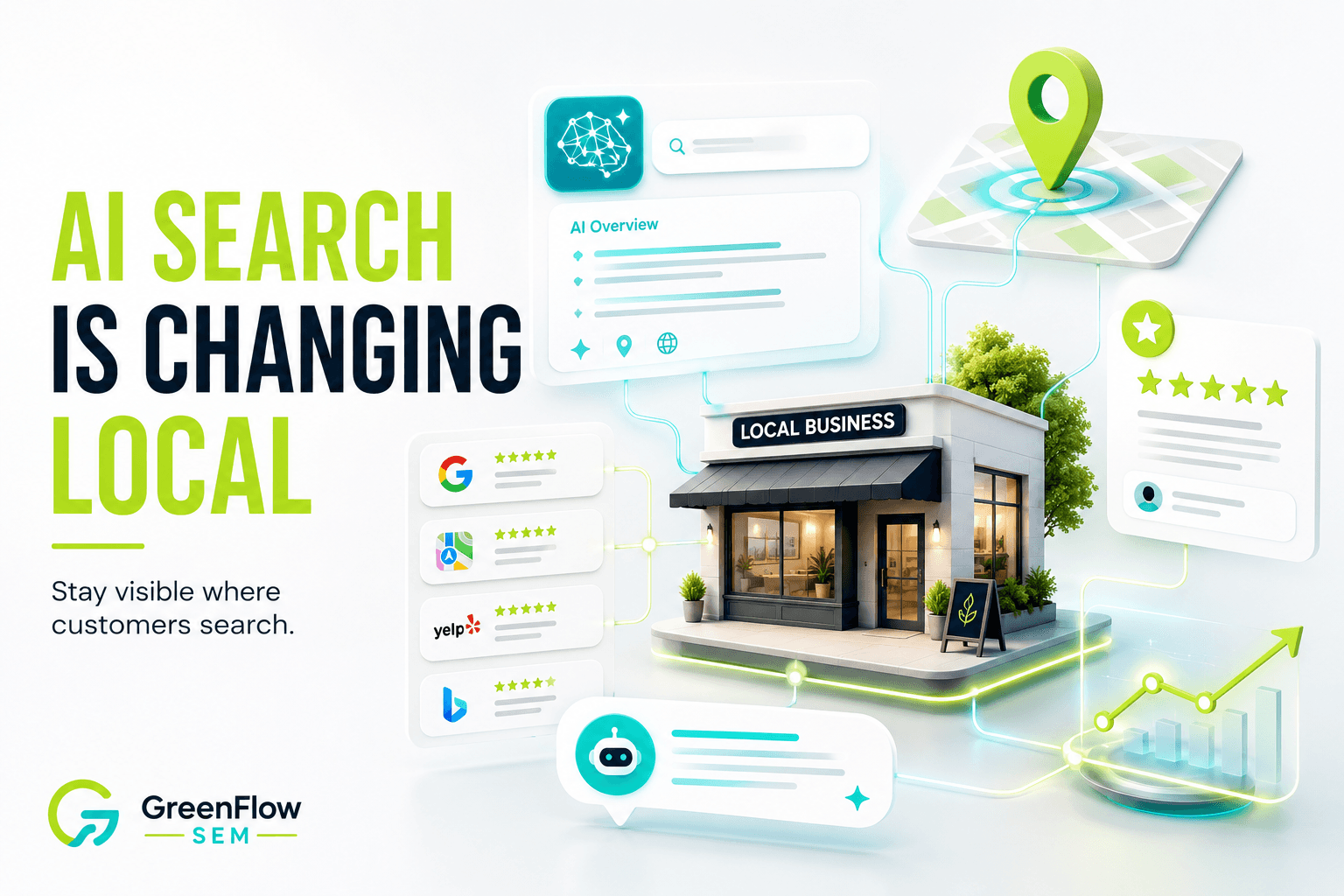
AI search is changing local marketing by replacing a list of blue links with a single generated answer that names only a handful of businesses. Instead of scrolling ten search results, a customer asking "best plumber near me" or "birria restaurant open now" often gets one paragraph with two or three business names already chosen for them. If your business isn't feeding the right data to those systems, you can lose visibility before a potential customer ever sees your website.
Staying visible means treating AI search as an extension of local SEO rather than a separate discipline. The same fundamentals that win the local map pack, a complete Google Business Profile, consistent citations, strong reviews, and clean structured data, are what feed AI Overviews, ChatGPT, and Perplexity. The businesses showing up in AI-generated answers are almost always the ones that already do local SEO well.
What Counts as "AI Search" in 2026?
AI search covers any tool that generates a written answer from web data instead of, or in addition to, a list of ranked links. For local businesses, the ones that matter most right now are:
- Google AI Overviews, which appear above traditional results for many informational and local queries
- Google AI Mode, a conversational search experience built into Google Search
- ChatGPT search, which browses the live web to answer questions
- Perplexity, an answer engine that cites sources directly
- Bing Copilot, Microsoft's AI layer on top of Bing search
These tools don't operate in isolation. Google's AI Overviews still draw heavily from the same local data (Google Business Profile, reviews, map data) that powers traditional local rankings. ChatGPT and Perplexity lean more on crawlable web content, directory listings, and review platforms. Either way, the underlying inputs are largely the same signals local SEO has always relied on.
How Does AI Search Actually Choose Which Businesses to Mention?
AI engines are trying to answer a question confidently and briefly. That means they favor businesses with information that is complete, consistent, and easy to verify across multiple sources. A business with a thin, outdated online presence is harder for an AI system to recommend with confidence, even if the business itself is excellent.
AI SEARCH SIGNAL MAP
- Google Business ProfileFeeds AI Overviews
- Customer reviewsBuilds trust signal
- Schema markupMachine-readable facts
- Citations (NAP)Confirms legitimacy
- Website contentAnswers real questions
Google Business Profile data anchors almost everything local, hours, categories, services, photos, and review counts all get pulled into AI Overviews and the local pack alike. Reviews do double duty: they signal trust to the AI system and often contain the exact language customers use, which helps match your business to real questions.
Schema markup and consistent citations matter because AI systems are, at their core, pattern-matching machines. When your business name, address, and phone number match everywhere and your website uses structured data to spell out what you do, it's easier for an AI engine to state facts about your business with confidence. Our schema markup guide walks through how to add this without touching code.
What's Different About Ranking in AI Answers vs Traditional Search Results?
Traditional SEO rewards ranking first for a specific keyword. AI search rewards being one of a small number of businesses an AI system chooses to synthesize into an answer, often pulled from several sources at once rather than a single winning page. That shifts the priority from chasing one keyword to being consistently correct and well-documented everywhere.
VISIBILITY FACTORS, RANKED BY IMPACT
- Google Business Profile completenessHighest impact
- Review volume and recencyHighest impact
- Schema markup
- Site speed and Core Web Vitals
- Traditional backlinksStill matters
This isn't a formula Google or any AI provider publishes, and no one outside those companies knows the exact weighting. But in the accounts we manage, businesses with a fully built-out Google Business Profile and a healthy stream of recent reviews consistently show up more often in AI-generated and local pack results than businesses that only invest in traditional link building.
Site speed still matters because a slow, hard-to-crawl website is harder for any search system, AI or traditional, to read and trust. If your site takes several seconds to load, that's worth fixing regardless of how AI search evolves. Our post on why slow websites lose leads covers what to check first.
How Do You Know If AI Search Is Already Sending You Traffic?
Most business owners can't see AI-driven visits directly, but there are a few practical ways to check:
- Look at GA4 referral traffic for sources like chatgpt.com, perplexity.ai, or bing.com
- Ask new customers how they found you, and listen for phrases like "I asked ChatGPT"
- Watch for an uptick in direct phone calls or GBP profile views without a matching increase in ad spend
- Track branded search volume over time; AI answers often drive people to search your business name directly afterward
None of these signals are perfect, and AI referral tracking is still evolving across analytics platforms. Treat this as directional evidence rather than a precise measurement.
What Should Local Businesses Do to Stay Visible in AI Search?
Get the Fundamentals Right First
A complete, accurate Google Business Profile is still the single highest-leverage thing a local business can control. That means correct categories, complete service lists, current hours, real photos, and a steady stream of posts. Our Google Business Profile checklist covers this in detail, and it's included in every Local SEO plan we run.
Make Your Business Data Machine-Readable
Schema markup translates your website into a format search engines and AI crawlers can parse directly, business type, service area, hours, reviews, and FAQs. This doesn't guarantee an AI mention, but it removes ambiguity that could keep you out of one.
Build a Real Review Engine
Reviews need to be recent, not just numerous. A business with 200 reviews from three years ago looks less current to both customers and AI systems than a business with 40 reviews, most from the last six months. A simple post-service text or email asking for a review, sent consistently, does more for AI visibility than almost any other single tactic.
Publish Content That Directly Answers Questions
AI engines favor content that answers a specific question plainly, in the first sentence or two, rather than content that buries the answer under paragraphs of introduction. If you write a page about your services, structure it so a reader (or an AI crawler) can find the direct answer immediately. Our guide on getting cited by ChatGPT and Perplexity goes deeper on how to structure this kind of content.
Keep Citations Consistent Everywhere
Your business name, address, phone number, and category should match exactly across your website, Google Business Profile, Yelp, industry directories, and any other listing. Inconsistent NAP data is one of the most common, and most fixable, reasons a business gets overlooked by both traditional and AI search.
Does AI Search Replace Google Ads or Local SEO?
No. AI Overviews and AI Mode results still appear alongside paid ads and the local map pack in most Google searches, they don't remove them. Local Services Ads and Google Ads campaigns continue to place your business directly in front of people actively searching to buy, regardless of whether an AI Overview also appears on the page.
AI search is best understood as a new layer on top of the same local search ecosystem, not a replacement for it. Businesses that pair strong SEO fundamentals with active Google Ads or Local Services Ads campaigns tend to show up more consistently across every surface a customer might use, whether that's a traditional search, a map pack listing, or an AI-generated answer. If you're weighing which to prioritize first, our post on Google Ads vs. Local Services Ads can help.
A Simple 90-Day Roadmap to AI Search Visibility
AI search visibility isn't built overnight. It compounds the same way traditional SEO does, through consistent, ongoing work rather than a one-time fix.
90-DAY VISIBILITY ROADMAP
- Audit your current visibilityWEEKS 1-2
- Fix the fundamentalsWEEKS 2-4
- Add structured data and FAQ contentWEEKS 4-8
- Monitor and refineWEEKS 8-12
The audit phase matters most because it tells you where the gaps actually are. A business with a strong Google Business Profile but inconsistent citations needs a different fix than one with great reviews but no schema markup at all. Skipping straight to content creation without fixing the fundamentals first tends to waste effort.
By the third month, most businesses have enough new reviews, cleaner data, and better structured content to start noticing a difference in both traditional local rankings and how often they get mentioned in AI-generated answers. This lines up with how local SEO has always worked: it's a compounding effort, not a switch you flip once.
How to Prioritize This Work in San Diego's Local Market
San Diego is a competitive local market across most service categories, from home services to restaurants to auto repair. That competition means the businesses with the most complete, consistent online presence tend to pull ahead in both traditional and AI-driven search. Our guide on building a local SEO strategy for San Diego businesses covers how to prioritize this work specifically for our market.
If you're not sure where your business currently stands, a free SEO audit is a straightforward way to see which of these signals need attention first.
Frequently Asked Questions
Do I need a different website just for AI search?
No. You need the same well-structured, fast, accurate website that serves traditional SEO well, with schema markup added so AI crawlers can parse your business information more easily. A full rebuild is rarely necessary unless your current site has deeper issues with speed or content quality.
Will AI Overviews reduce clicks to my website?
AI Overviews can reduce clicks for some informational searches, since the answer appears directly on the results page. For local, transactional searches like "emergency plumber near me," people still typically need to call, visit, or book, which usually means clicking through to a phone number, map listing, or website regardless of whether an AI summary is present.
Key Takeaways and Next Steps
AI search is reshaping how customers find local businesses, but it runs on the same underlying signals local SEO has always depended on: a complete Google Business Profile, consistent citations, recent reviews, clean schema markup, and content that answers questions directly. Businesses that already invest in these fundamentals tend to show up in AI-generated answers without needing an entirely separate strategy.
- This week, check your Google Business Profile for outdated hours, missing services, or thin descriptions
- Search your own business name and NAP data across your website, GBP, and top directories to spot inconsistencies
- Ask your last five satisfied customers for a review if you haven't already
- Read through your website's top service pages and confirm the direct answer appears in the first sentence or two
These changes take a few hours and don't require any technical background. If you'd rather have someone audit your current visibility and handle the fixes, from Google Business Profile to schema markup to ongoing content, our Local SEO and SEO plans include this work, and a free SEO audit or a quick call is a low-pressure way to see where you stand.