Retargeting: Win Back the 97% Who Didn't Convert
Most website visitors leave without converting. Here's how small businesses use retargeting to bring them back, what it costs, and how to do it well.
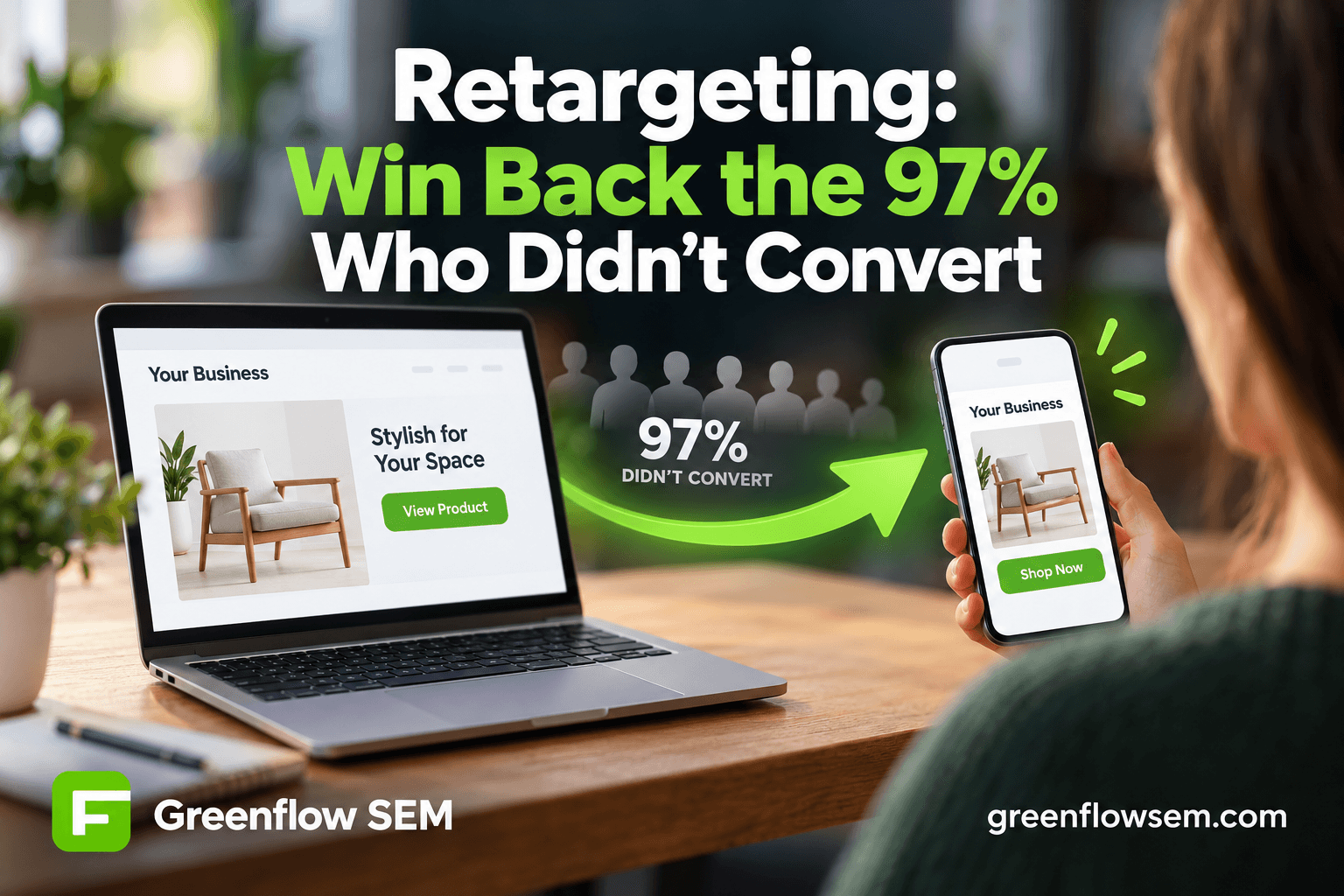
Retargeting is the practice of showing ads again to people who already visited your website, watched your video, or interacted with your business but didn't buy, call, or fill out a form. It works because most visitors never convert on the first visit, so retargeting gives you a second, third, or fourth chance with someone who's already shown interest.
Industry benchmarks commonly put average website conversion rates somewhere between 2% and 5%, depending on the industry and traffic source. That's the math behind the '97% didn't convert' framing: the overwhelming majority of people who land on a small business website leave without taking action, and most of them are gone for good unless something brings them back.
Why Do So Many Visitors Leave Without Converting?
Not converting doesn't mean a visitor wasn't interested. In the accounts we manage, the most common reasons people leave without acting have very little to do with the business itself.
- They were researching, not ready to buy or book yet
- They got distracted by a phone call, a notification, or another tab
- They wanted to compare two or three options before deciding
- The page took too long to load and they bailed before it finished
- They were on mobile and planned to finish the form later, then forgot
A slow, clunky, or confusing site makes this worse. If pages load slowly or the path to contact you isn't obvious, you lose people before retargeting even gets a chance to work. We cover this in detail in why slow websites lose leads.
THE TYPICAL WEBSITE FUNNEL
- Visit the site100
- Browse 2+ pages40
- Start a form or call12
- Actually convert3
OUT OF EVERY 100 VISITORS
This isn't a prediction of what will happen on any specific website, it's an illustration of the general pattern. The exact numbers vary by industry, traffic quality, and how well the site is built. But the shape of the funnel is consistent: a small slice of visitors converts right away, and a much larger group leaves in the middle, still mildly interested but not ready to act.
Retargeting targets that middle group specifically. It doesn't try to reach brand-new strangers. It tries to bring back people who already looked, which is a fundamentally easier audience to persuade a second time.
How Does Retargeting Actually Work?
Retargeting relies on tracking who visited your site or engaged with your content, then showing that specific group of people ads afterward, wherever they go online.
Pixel-Based Retargeting
A small snippet of code, often called a pixel or tag, sits on your website and tracks visitors anonymously. When those visitors later browse other sites, watch YouTube, or scroll Facebook and Instagram, the ad platform recognizes them and can serve your ad. This is the most common form of retargeting for small businesses because it requires no extra work from the visitor. Accurate tracking is the foundation here, which is why we always start with solid conversion tracking before building retargeting audiences on top of it.
List-Based Retargeting
You can also upload a list of emails or phone numbers, such as past customers or newsletter subscribers, and platforms will match them to user accounts and show ads to that group. This works well for re-engaging past customers with a seasonal promotion or a new service, separate from anyone who merely browsed the site once.
Which Retargeting Platforms Make Sense for Small Business Budgets?
Most small businesses don't need every retargeting channel at once. The right starting point depends on where your audience spends time and what kind of decision they're making.
RETARGETING CHANNELS AT A GLANCE
- Google Display & YouTubeFollows visitors across millions of sitesLow cost, broad reach
- Meta (Facebook & Instagram)Visual, social-first audiencesStrong for visual brandsSocial Ads
- Search remarketing (RLSA)Past visitors who search againHigh purchase intent
- Email retargetingVisitors who already gave an emailLowest added cost
Google Display and YouTube remarketing tend to have a low cost per impression and work well for staying visible while someone keeps researching. They run under a standard Google Ads campaign alongside search.
Meta retargeting through Social Ads tends to work especially well for businesses with a visual product or service, like restaurants, contractors, or retail, where a photo or video can remind someone why they clicked in the first place. Search remarketing, where you bid differently on people who've already visited when they search again on Google, is one of the highest-intent forms of retargeting because the person is actively looking again.
Email retargeting doesn't require ad spend at all, just a list and a reason to reach out, which makes it a good first step for businesses not ready to run paid retargeting yet.
How Do You Build a Retargeting Campaign That Doesn't Annoy People?
Retargeting has a reputation problem because it's easy to do badly. People notice when the same ad follows them around for months, and that annoyance works against the brand instead of for it.
RETARGETING DOS AND DON'TS
- Cap how often one person sees the adPrevents fatigue and annoyance
- Exclude people who already convertedStops wasting budget on customers
- Segment audiences by page they viewedKeeps messaging relevant
- Run the same ad for monthsFeels stale, gets ignored
- Target anyone who bounced in 2 secondsLow intent, wastes spend
Frequency capping, which limits how many times one person sees your ad in a given period, is one of the simplest fixes. So is excluding recent converters from your retargeting audience, which both platforms let you do. If someone already booked an appointment or filled out your contact form, showing them the same ad again wastes budget and can come across as careless.
Segmenting audiences matters just as much. Someone who viewed your pricing page is further along than someone who read one blog post and left. Showing both groups the same generic ad ignores that difference. It also matters where the ad sends people back to. Retargeting someone to your homepage, when they were already looking at a specific service, adds friction right when you're trying to remove it. We've written about this in landing pages vs. homepages, and the same logic applies directly to retargeting: send people back to the page closest to what they were already looking at, not a generic starting point.
What Does Retargeting Cost, and Is It Worth It?
Retargeting is usually cheaper per click or impression than cold prospecting, because the audience is smaller and more defined, and the platform doesn't have to work as hard to find an interested person. It's typically run as a piece of a broader Google Ads or social ads account rather than a standalone budget line.
For reference, our management pricing starts at $700/mo for Google Ads, which includes display and search remarketing, and $750/mo for Social Ads, which includes Meta retargeting. Local Services Ads, priced separately at $500/mo flat, work differently and don't support retargeting the way search and social campaigns do, since leads come through Google's own call and message system. You can see a full breakdown of how LSA pricing works in our Local Services Ads pricing guide.
Whether retargeting is worth it comes down to volume. A business with very little website traffic won't build a meaningful retargeting audience quickly, since most platforms need a minimum pool of visitors before ads can even run efficiently. A business with steady traffic, even a modest amount, usually has enough people visiting and leaving to make retargeting a reasonable piece of the budget. If you're still working out what to spend across channels overall, our guide on how much to spend on Google Ads and our broader marketing budget guide are good starting points.
What Should You Track to Know If Retargeting Is Working?
Retargeting campaigns should be measured separately from your cold-traffic campaigns, since they behave differently and usually convert at a different rate.
- Conversion rate for retargeted visitors compared to new visitors
- Cost per conversion, which should typically be lower than cold campaigns
- Frequency, so you can catch ad fatigue before it hurts performance
- View-through conversions, when someone sees an ad but converts later without clicking
All of this depends on conversion tracking being set up correctly in the first place. If a business can't tell which conversions came from retargeted visitors versus new ones, it's essentially guessing at what's working. We walk through the setup basics in 10 Google Ads metrics every business owner should know.
Bringing Back the 97%: Key Takeaways and Next Steps
Most website visitors leave without converting, not because they weren't interested, but because they weren't ready yet. Retargeting is how you stay in front of that group instead of losing them for good. Pixel-based retargeting reaches anonymous past visitors, list-based retargeting reaches people you already have contact information for, and the channel you choose, whether that's Google Display, YouTube, Meta, search remarketing, or email, should match where your audience spends time.
The businesses that get the most out of retargeting cap how often ads show, exclude people who already converted, segment by what the visitor actually looked at, and send people back to a relevant page instead of a generic homepage.
This week, you can take a few concrete steps on your own:
- Confirm your Google Ads and Meta pixels are installed and firing correctly on your site
- Check how many people your site gets monthly to see if you have enough traffic to build a retargeting audience
- Look at your top two or three service or product pages and make sure they load quickly and make sense as a standalone landing page
- Set up an exclusion audience for people who already converted, so you're not paying to show them ads after the fact
If you'd rather not untangle pixels, audiences, and frequency caps yourself, that's the kind of setup we handle regularly for clients across Google Ads and social campaigns. You can start with a free Google Ads audit to see what's already in place, or book a call to talk through whether retargeting makes sense for your traffic and budget right now.