Responding to Negative Google Reviews the Right Way
Learn how to respond to negative Google reviews without hurting your rankings or reputation, with a framework, examples, and mistakes to avoid.
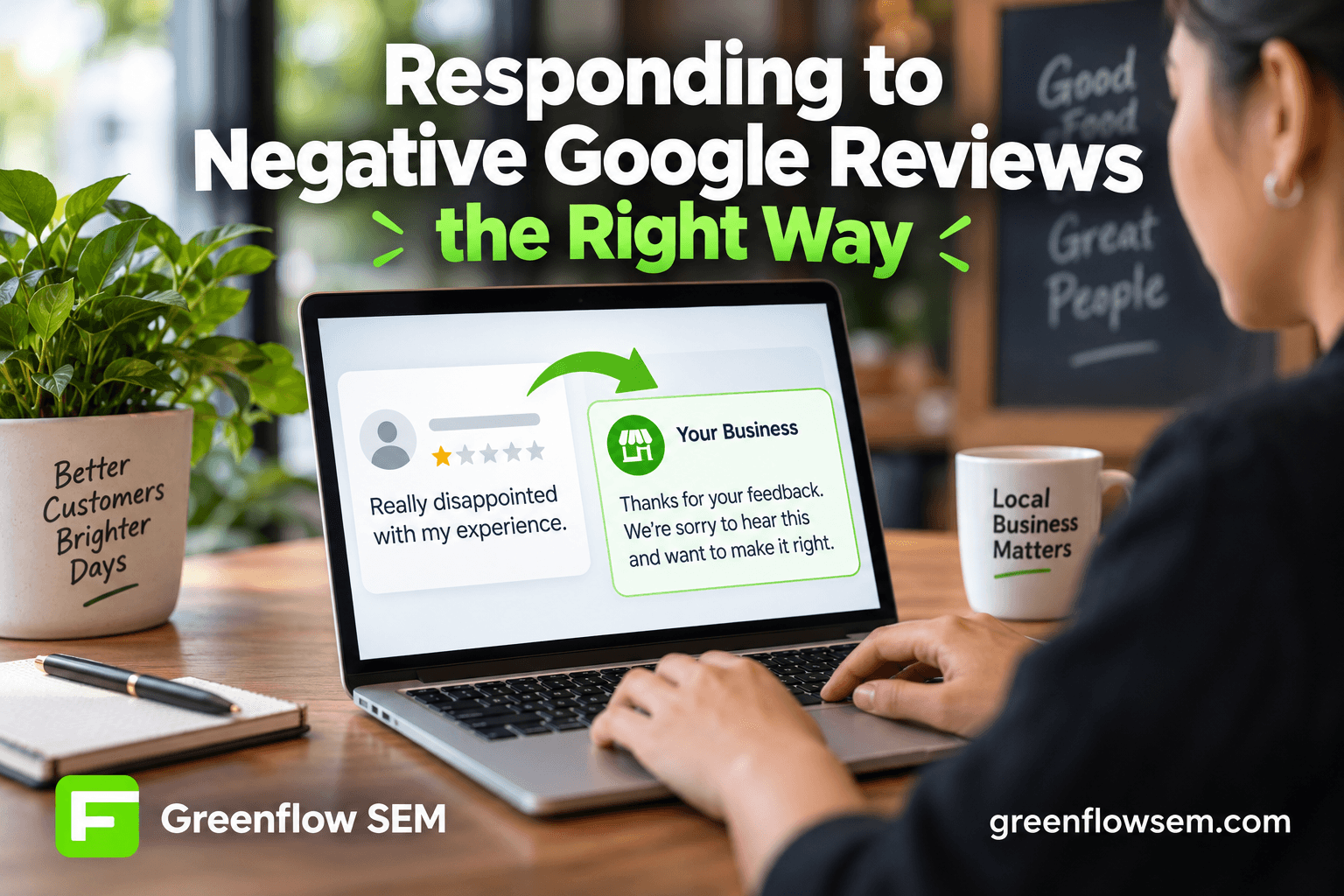
A negative Google review will not hurt your rankings. A bad response to one might. Google's local algorithm cares about review quantity, recency, and overall rating trends, not whether one customer had a rough experience. What actually damages a business is a defensive, argumentative, or silent response that drives future customers away and signals a profile nobody is managing.
In this guide, we'll walk through exactly how to respond to negative reviews in a way that protects your reputation, keeps your Google Business Profile healthy, and sometimes even turns an unhappy customer into a repeat one. We'll also cover what to do when a review is fake, abusive, or violates Google's policies.
Do Negative Reviews Actually Hurt Your Rankings?
Not directly, and not from a single bad review. Google has been consistent in its own guidance: review count, review recency, and overall rating are factors in local search and map pack visibility, but one low-star review among dozens of positive ones has minimal effect on where you rank. What matters more is the pattern over time.
A business with 150 reviews at a 4.6 average and a steady trickle of new reviews each month will almost always outrank a competitor with 12 reviews at a perfect 5.0, because Google reads volume and freshness as signals of a real, active, trusted business. If you want the full breakdown of how reviews fit into map pack visibility alongside proximity and relevance, we cover it in How to Rank in the Google Map Pack: 3 Factors.
Where things get risky is not the review itself, it's the response. A profile with public arguments, defensive replies, or a visible pattern of ignoring complaints can quietly erode trust with the people deciding whether to call you. Rankings get you seen. Reviews and responses decide whether being seen turns into a lead.
What a Bad Response Actually Costs You
Most of the damage from negative reviews comes from how the business owner handles the reply, not the original complaint. Prospective customers read reviews in order, see the one-star comment, then immediately check for a response. What they find there often matters more than the complaint itself.
RESPONSE DO'S AND DON'TS
- Acknowledge the specific complaint
- Thank the reviewer for the feedback
- Offer to continue the conversation offline
- Argue the details publicly in the reply
- Post the same copy-pasted reply every time
- Reveal private customer details or order history
The mistakes on the right side of that list tend to show up in clusters. A business that argues with one reviewer usually argues with several, and once a pattern like that is visible, it stops looking like a one-off bad day and starts looking like how the business treats customers generally.
Revealing private details is also a policy violation under Google's review guidelines, and Google can remove the response or, in repeated cases, restrict posting privileges on the profile. If you've ever had a profile flagged or suspended over policy issues, our guide on how to fix a suspended Google Business Profile walks through the recovery process.
A Simple Framework for Responding to Negative Reviews
Most negative review responses go wrong because the owner replies in the heat of the moment. A short pause and a consistent process fix almost every bad outcome. Here's the sequence we recommend to the local businesses we work with.
A 5-STEP RESPONSE FRAMEWORK
- Read and verifyHOUR 1
- Acknowledge the specific issueHOUR 1
- Apologize for the experienceHOUR 2
- Move the details offlineHOUR 2
- Follow through and ask for an updateWEEK 1
The step that gets skipped most often is moving details offline. Public back-and-forth about a specific invoice, appointment time, or employee name rarely helps either side, and it gives every future reader a front-row seat to a dispute they have no context for. A simple line like "please call us at [number] so we can make this right" closes the public loop while keeping the real conversation private.
Speed matters too. A reply posted within a day or two reads as attentive. A reply posted three weeks later, after the business clearly had time to think it over, reads as reluctant. If speed is a recurring challenge across your customer communication generally, not just reviews, our post on speed to lead covers why fast responses win more business across the board.
How to Respond to Different Types of Negative Reviews
Not every one-star review deserves the same tone. A legitimate service complaint, a misunderstanding, and a fake review from a competitor all call for different handling.
The legitimate complaint
If the customer has a real point, say so plainly. "You're right that we should have called ahead to confirm the appointment time, and we're sorry we didn't" costs you nothing and earns real credibility with everyone else reading it. Owning a mistake publicly is one of the fastest ways to build trust with future customers who are actively comparison shopping.
The misunderstanding
Sometimes a customer misremembers pricing, scope, or timeline. Correct the record politely and factually, without accusing them of lying. "Our records show the estimate included permit fees, which we outlined in the written quote. We'd welcome the chance to walk through it together, please give us a call" sets the record straight without a public fight.
The review that breaks Google's policies
Some reviews aren't feedback at all. They're spam, posted by a competitor, written by someone who was never a customer, or contain hate speech, threats, or off-topic content. These can be flagged for removal directly through your Google Business Profile.
- Reviews posted by someone with no evidence of being a customer
- Reviews that reference a different business entirely
- Reviews containing hate speech, threats, or explicit content
- Reviews that are clearly spam or posted in bulk
- Reviews that disclose someone else's private information
Flagging takes a few days to a few weeks for Google to review, and not every flag results in removal, even when the review feels unfair. Don't wait on the flag before responding. Post a calm, factual public reply while the flag is pending, since there's no guarantee it gets removed and the reply will outlast the review either way.
Should You Ever Delete or Ignore a Negative Review?
You can't delete a customer's review yourself, only Google can remove one, and only if it violates their content policies. Ignoring a negative review is technically possible, but it's rarely the right call. An unanswered one-star review next to a dozen thoughtful replies to five-star reviews stands out, and not in a good way.
The one exception is an obviously bad-faith review with zero chance of reasonable resolution, like a rant from someone who admits in the text they never actually used your business. In that narrow case, flag it, skip a public reply, and move on. For everything else, a short, professional response is worth the five minutes it takes.
How Review Responses Fit Into Local SEO Long Term
Responding to reviews isn't a confirmed direct ranking factor the way proximity or category selection is, but it's part of a broader pattern Google and customers both read as activity and trustworthiness. A profile that's updated, responded to, and clearly managed tends to perform better across the board, not because of the replies alone, but because it usually comes paired with more reviews, better completeness, and more consistent posting.
WHAT ACTUALLY INFLUENCES MAP PACK RANKING
- Review quantityMore signals, more trust
- Review recencyFresh reviews matter most
- Average star ratingTrend over perfection
- Owner response rateTrust signal, not rank
- Keywords mentioned in reviewsMinor relevance boost
This is why we tell clients not to obsess over the ranking impact of any single response and instead focus on the habit of responding consistently. A business that replies to every review, good or bad, within a day or two builds a visible track record that compounds over months. That compounding effect matters more for conversion than for position in the map pack itself.
If you're earning very few reviews to begin with, the response strategy matters less than the volume problem. Our guide on how to get more Google reviews covers ethical ways to build review volume without asking for favors or violating Google's policies, and our Google Business Profile optimization checklist covers the rest of what a fully optimized profile looks like.
Building a Review Response Habit That Scales
For a single-location business, responding to reviews is a five-minute weekly task. For a multi-location business, it can become a real operational gap if it's left to whoever happens to notice the notification. A few practices keep it manageable as review volume grows.
- Assign one person, not a rotating group, to own review responses
- Set a standing rule: all reviews get a reply within 48 hours
- Write a short internal style guide so tone stays consistent across responders
- Review the full profile monthly, not just new reviews, to catch anything missed
- Track recurring complaints as operational feedback, not just reputation management
That last point is worth sitting with. If three different reviews over six months mention the same scheduling issue or the same employee, that's not a review problem anymore, it's an operations problem that happens to be getting documented publicly. Businesses with multiple locations face this at a larger scale, and our post on local SEO for multi-location businesses covers how to manage review consistency across several profiles at once.
Key Takeaways and What to Do This Week
A single negative review is not a ranking threat. It's a reputation moment, and how you respond to it shapes whether the next ten people who read it still call you. Respond quickly, acknowledge the specific complaint, move details offline, and save flagging for reviews that actually violate Google's policies. Build a consistent habit instead of reacting review by review.
This week, pull up your Google Business Profile and check for any unanswered reviews, especially negative ones. Draft a short, specific reply to each one using the framework above. If you find reviews that look fake or policy-violating, flag them through your profile dashboard. Then set a recurring reminder, weekly is plenty, so this never piles up again.
If managing reviews, your profile, and the rest of your local presence feels like one more thing competing for your time, that's exactly what our Local SEO service is built to take off your plate, with Google Business Profile management, citations, and review strategy included in every plan. Feel free to book a call if you'd rather have it handled than worry about it.