San Diego Google Ads: More Qualified Leads
Learn how San Diego businesses use Google Ads management to generate more qualified leads, not just clicks, with proven targeting and tracking tactics.
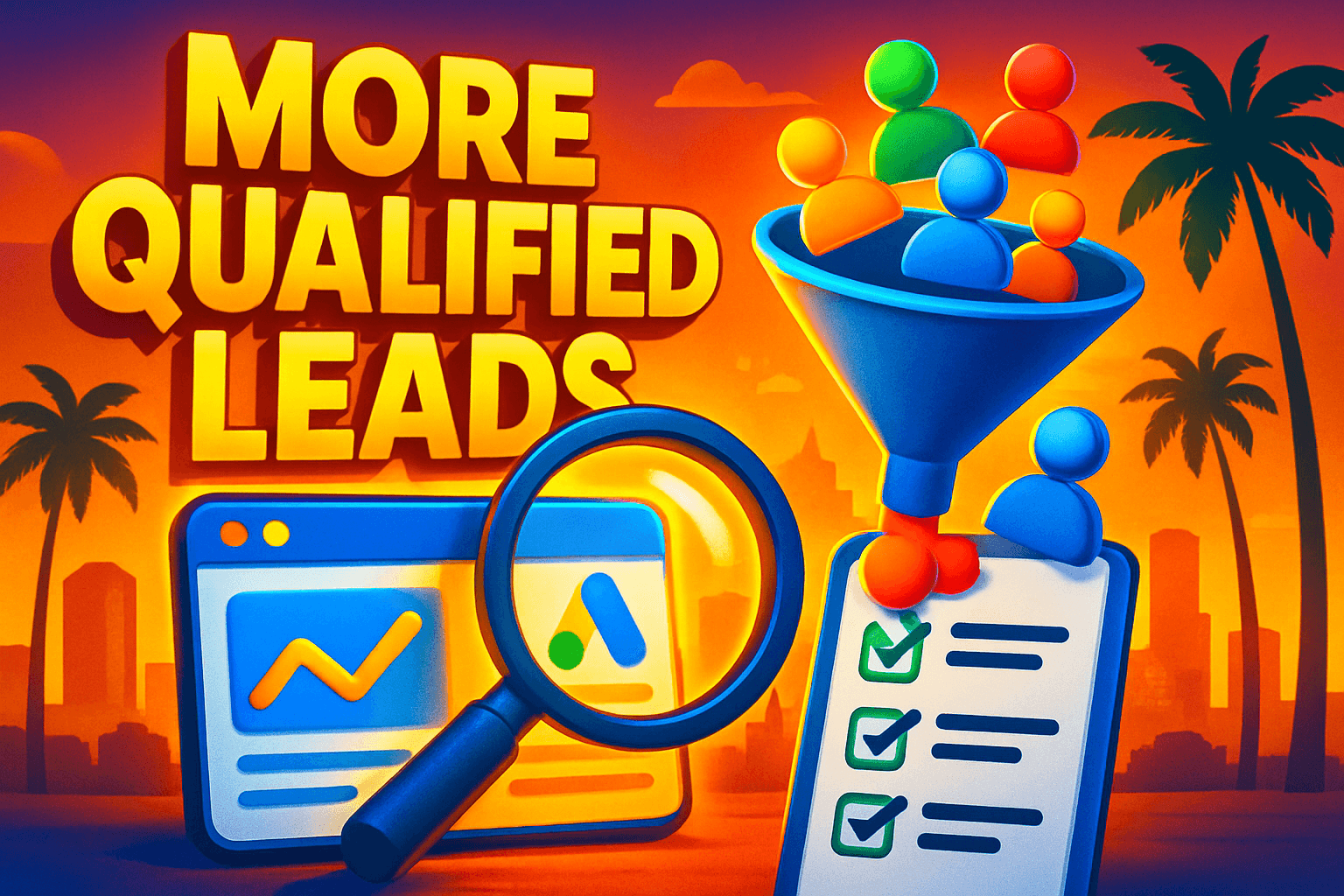
Getting more qualified leads from Google Ads in San Diego comes down to three things working together: keyword targeting that matches real buyer intent, a landing page built to convert the traffic you're paying for, and conversion tracking accurate enough to tell you which clicks actually turn into customers. Accounts that get these three right consistently produce better leads than accounts that simply chase clicks or impressions.
This guide walks through what a qualified lead actually looks like in a Google Ads account, how keyword and landing page decisions shape lead quality, how to track results correctly, and how much San Diego businesses typically need to budget to see real traction.
What Does a Qualified Lead Actually Mean in Google Ads?
A click is not a lead, and a lead is not automatically qualified. Google Ads reports clicks and conversions, but neither metric tells you whether the person who converted is actually in your service area, ready to buy, or looking for what you sell. A qualified lead is someone who matches your target customer profile closely enough that your sales team or booking process can reasonably close them.
In practice, that means a qualified lead usually has most of these traits:
- Lives or works within your actual service area
- Is searching for the specific service or product you offer, not a related but different one
- Has the budget or authority to make a purchase decision
- Is close enough to buying that a phone call or form fill leads somewhere
Clicks, Conversions, and Qualified Leads Are Different Numbers
It helps to think of Google Ads results as a funnel. Someone sees your ad, clicks it, lands on your page, and a portion of those visitors convert by filling out a form or calling. Only a portion of those conversions turn out to be qualified once your team actually talks to them. Every stage of that funnel loses some volume, and the goal of good Google Ads management is to shrink the drop-off between clicks and qualified leads, not just drive more clicks.
FROM CLICK TO QUALIFIED LEAD
- Landing page views15545
- Ad conversions2900
- Qualified leads1500
- Phone calls900
$0.26
Cost per landing page view
$7.54
Cost per qualified form lead
SD FOOD TRUCK PROS CAMPAIGN DATA
These numbers come from the SD Food Truck Pros case study, a California food truck manufacturer that paired a conversion-focused website with tightly managed Google Ads and social campaigns. The point isn't that every account will see these exact figures. It's that the funnel shape matters more than any single metric. A campaign generating thousands of cheap clicks that never convert is worse than one generating fewer, more expensive clicks that consistently turn into calls and quote requests.
This is also why Quality Score matters beyond just lowering your cost per click. Ads that are relevant to the search, backed by tight keyword groups and strong landing pages, tend to attract searchers who are closer to ready. We cover this in more detail in Google Ads Quality Score: What It Is and How to Improve It.
How Does Keyword Strategy Shape Lead Quality?
Keyword and match type decisions are the first filter for lead quality. Broad match keywords without a solid negative keyword list will show your ads for searches that are only loosely related to what you offer, which drives cheap clicks that rarely convert into real business. Tighter match types paired with an active negative keyword list narrow the audience down to people whose searches actually match your services.
KEYWORD SETUP AND LEAD QUALITY
- Broad match, no negativesLow quality clicks
- Phrase match, few negativesMixed quality
- Exact match, full negativesHigher quality leads
- Branded and competitor termsIntent dependent
In the accounts we manage, negative keyword lists are never a one-time setup. Search term reports need regular review so irrelevant queries get blocked before they drain budget. A concrete contractor running ads for driveway installation, for example, doesn't want to pay for clicks from people searching for DIY concrete tutorials or unrelated repair jobs. Belcrete Concrete Services saw its cost per click drop by more than 50% while conversion rate rose to 20 to 30 percent after tightening search targeting around the specific services it actually performs.
A few keyword habits consistently improve lead quality:
- Group keywords tightly by service so ad copy and landing pages can speak directly to the search
- Review the search terms report weekly during the first few months of a campaign
- Add negative keywords proactively for services you don't offer, job seekers, and research-only terms
- Use location targeting to match your actual service area instead of casting a wide net
Why Your Landing Page Decides Whether Clicks Become Leads
Even a perfectly targeted keyword strategy fails if the landing page doesn't hold up. Once someone clicks your ad, the page they land on needs to load quickly, speak directly to their search, and make it easy to call or fill out a form. Sending Google Ads traffic to a generic homepage instead of a page built for that specific offer is one of the most common reasons paid clicks don't convert.
Page speed matters more than most advertisers realize. Google's own Core Web Vitals research and general conversion data both show that slow-loading pages lose visitors before they ever see your offer. We go into this in depth in Why Slow Websites Lose Leads (and How to Fix Core Web Vitals). If you're paying for clicks, a slow landing page is money spent generating traffic that leaves before it converts.
A landing page built for Google Ads traffic should generally include:
- A headline that matches the search intent of the ad group sending traffic to it
- A clear call to action, ideally both a phone number and a short form
- Fast load times on both desktop and mobile
- Trust signals like reviews, licenses, or before-and-after photos relevant to the service
- No unnecessary navigation links pulling visitors away before they convert
Magnolia Smog Check is a good example of what happens when targeting and landing experience work together. The station combined a fully optimized local presence with tightly targeted Google Ads and converted 40 to 45 percent of its ad traffic while tripling customer volume. That kind of conversion rate rarely comes from the ad alone. It comes from sending the right searcher to a page built specifically to answer their question and get them to act.
How Should You Track and Measure Lead Quality?
You can't improve what you can't measure, and clicks or form fills alone don't tell the full story. Accurate tracking closes the loop between ad spend and actual business outcomes.
- Set up conversion tracking for every meaningful action: form submissions, phone calls, chat starts, and booking confirmations
- Use call tracking numbers so phone leads from Google Ads are counted separately from organic or walk-in calls
- Import offline conversions back into Google Ads when a lead turns into a paying customer, so the platform's bidding algorithms learn from real outcomes, not just form fills
- Tie ad performance back to your CRM or booking system whenever possible to see which keywords and campaigns produce customers, not just leads
This kind of tracking is also what makes automated bid strategies like Target CPA or Target ROAS actually work well. Google's bidding systems optimize toward whatever conversion action you tell them to optimize for. If that action is a low-value form fill instead of a qualified lead, the algorithm will happily bring you more low-value form fills. Feeding it better signal is one of the highest-leverage changes an account can make.
What Should a San Diego Google Ads Budget Look Like?
Budget needs vary by industry, competition, and average customer value, but most small businesses should plan for both a management fee and a separate ad spend budget. GreenFlow SEM's Google Ads management starts from $700 per month, on top of whatever budget goes directly to Google for clicks. We break down how to think about total spend, including ad budget sizing by industry, in How Much Should a Small Business Spend on Google Ads in 2026?.
San Diego's competitive categories, including home services, restaurants, and auto repair, tend to have higher cost per click than smaller markets, so budgets need to account for that instead of assuming national average numbers will apply locally. Seasonal shifts matter too. A business with a busy summer and a slow winter shouldn't run a flat budget year-round; we cover how to adjust for that in Seasonal Google Ads: Adjusting Budgets for Busy and Slow Months.
Google Ads or Local Services Ads First in San Diego?
Many San Diego service businesses ask whether they should start with Google Ads search campaigns or Local Services Ads, Google's pay-per-lead product for home services and a handful of other categories. The honest answer is that it depends on your business type and how much control you want over targeting.
GOOGLE ADS VS LOCAL SERVICES ADS
- Google AdsSearch, display, and remarketingFrom $700/moBest for control
- Local Services AdsPay only for verified leadsPay-per-leadBest for service pros
Google Ads gives full control over keyword targeting, ad copy, and the landing page experience, which is why it tends to produce more consistent lead quality once it's optimized. Local Services Ads charges per lead rather than per click and includes the Google Guaranteed badge, which can build trust quickly for newer businesses. Many home service businesses eventually run both. For a full side-by-side comparison, see Google Ads vs. Local Services Ads: Which Should Your Business Run First? and our Local Services Ads pricing guide. We also manage Local Services Ads campaigns directly for clients who want both channels running together.
Common Mistakes That Attract Unqualified Clicks
Most lead quality problems in Google Ads accounts trace back to a handful of repeatable mistakes. Fixing these usually improves lead quality faster than increasing budget.
LEAD QUALITY CHECKLIST
- Building tight, single-theme ad groups
- Sending all traffic to the homepage
- Reviewing search terms weekly
- Ignoring the negative keyword list
- Tracking calls and form fills separately
- Optimizing only for cheapest cost per click
A business that only measures success by cost per click will eventually train its own campaigns to attract cheap, low-intent traffic. A business that measures cost per qualified lead, and adjusts targeting and landing pages based on that number, ends up with a campaign that gets more efficient over time instead of less. If you're evaluating whether your current setup follows these habits, our free Google Ads audit reviews account structure, tracking, and landing pages against this exact checklist.
What Should You Do Next?
Getting more qualified leads from Google Ads in San Diego comes down to matching tight keyword targeting with a landing page built to convert, then tracking results accurately enough to know which clicks actually became customers. Clicks and even conversions are easy to generate. Qualified leads take deliberate account structure, disciplined negative keyword management, and a feedback loop between your ads and your actual sales outcomes.
This week, you can start with a few concrete steps on your own:
- Pull your search terms report and flag any queries that clearly don't match what you offer
- Check whether your Google Ads traffic lands on a dedicated page or your general homepage
- Confirm that phone calls and form submissions are both being tracked as conversions
- Compare your cost per lead against your average customer value to see if your current targeting makes financial sense
If you'd rather have someone review this for you, our free Google Ads audit is a no-pressure way to see exactly where your account is losing lead quality. And if you're still comparing agencies before committing to anyone, our guide on how to choose a Google Ads agency in San Diego walks through the right questions to ask. When you're ready to talk specifics, you can always book a call with our team.