Win "Near Me" Searches in San Diego
Learn how San Diego businesses show up for "near me" searches: Google Business Profile, location pages, reviews, and citations explained.
Optimizing for "near me" searches in San Diego means getting three things right at once: a fully built-out Google Business Profile, a website that proves your service area with real local content, and enough reviews and citations to tell Google you're a trustworthy, established business. None of these work in isolation.
Google stopped relying on the literal words "near me" years ago. It now infers location intent from almost every search, whether someone types "plumber near me" or just "plumber." That means the businesses winning these searches aren't necessarily closest, they're the ones that match the search intent, sit in the right spot on the map, and have the review and citation strength to back it up.
How Does Google Decide Which San Diego Businesses Show Up Nearby?
Google's local algorithm weighs three factors for every map pack and "near me" result: relevance, distance, and prominence. Understanding how these interact matters more than chasing any single tactic.
Google's three local ranking factors
- RelevanceMatches search intent
- DistanceCloser often wins
- ProminenceReviews & authority
Relevance is whether your Business Profile and website content actually match what someone searched for. Distance is roughly how close your listed address or service area is to the searcher. Prominence covers everything else: review volume and rating, citation consistency, and how well-known your business is online.
A business a mile farther away can still outrank a closer competitor if its relevance and prominence are stronger. This is why we've written in detail about the specifics in How to Rank in the Google Map Pack: 3 Factors. It's worth understanding before you spend time on any single fix.
Why Location Alone Isn't Enough
Plenty of San Diego business owners assume that having a physical address in the right zip code is enough to win nearby searches. It isn't. We regularly see businesses with a perfect location lose map pack spots to competitors a few miles further out simply because their profile is thinner, their reviews are older, or their website gives Google less to work with.
Is Your Google Business Profile Doing Its Job?
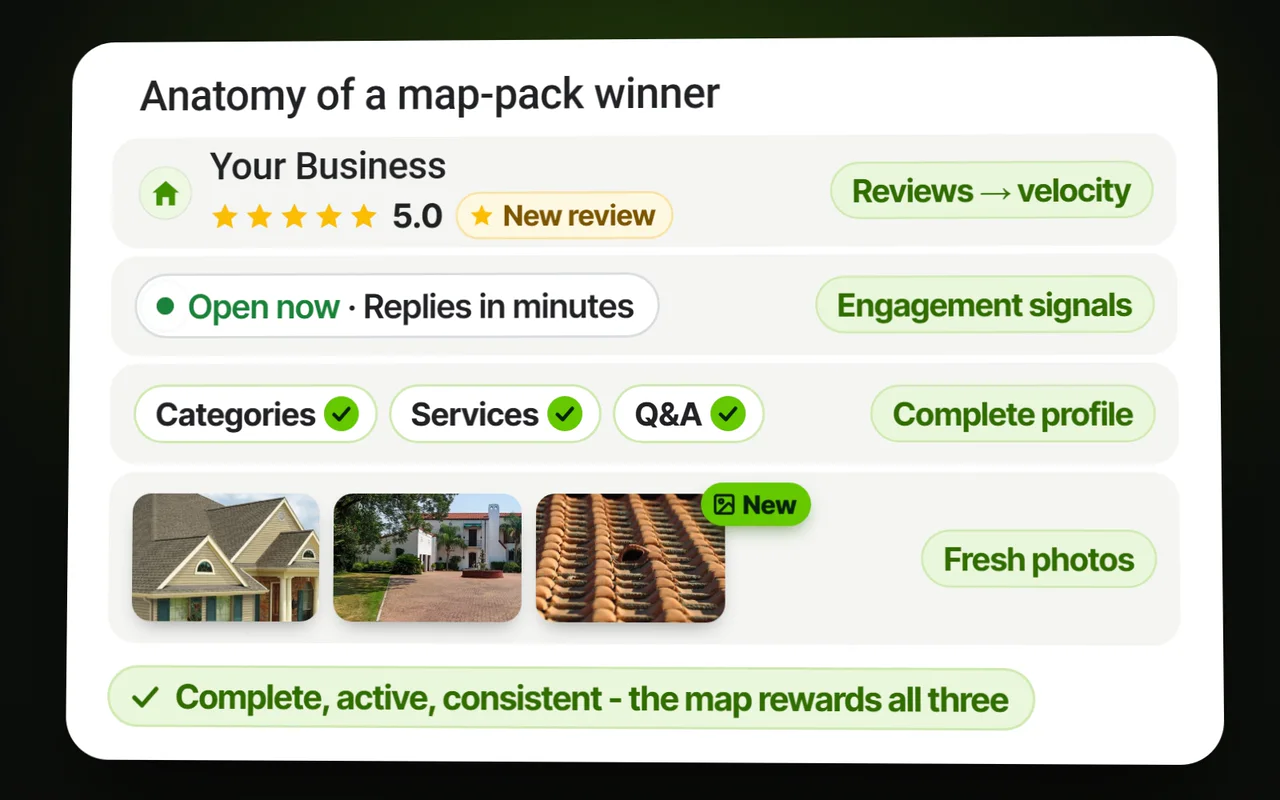
Your Google Business Profile is the single biggest lever for "near me" visibility. It's the record Google pulls from most directly when deciding who to show. Most profiles we audit are missing obvious pieces.
GOOGLE BUSINESS PROFILE: DO vs. DON'T
- Do: Set a precise primary category
- Do: List every service with a short description
- Do: Add new photos every quarter
- Avoid: Leave hours blank or outdated
- Avoid: Stuff keywords into your business name
- Avoid: Let new reviews sit unanswered for weeks
Your primary category has an outsized effect on which searches you're eligible to show up for at all. If you're not sure yours is right, our Google Business Profile Optimization checklist walks through category selection, service lists, attributes, and photo strategy in detail.
- Confirm your primary category is the most specific accurate option, not the broadest one
- Add secondary categories only if they're genuinely relevant
- Fill in every service with a short, specific description
- Keep your business name exactly as it appears on your storefront and signage
- Set your service area correctly if you don't serve walk-in customers at a fixed address
Service area businesses, like most trades, have an extra layer to get right. If your profile is showing you in cities you don't actually serve (or missing ones you do), see Fix a Google Business Profile Wrong Service Area. A mismatched service area quietly costs visibility in exactly the nearby searches you want to win.
If managing all of this ongoing feels like more than you want to take on, a map pack optimization service handles the recurring work: new photos, posts, Q&A monitoring, and category adjustments as Google's categories change.
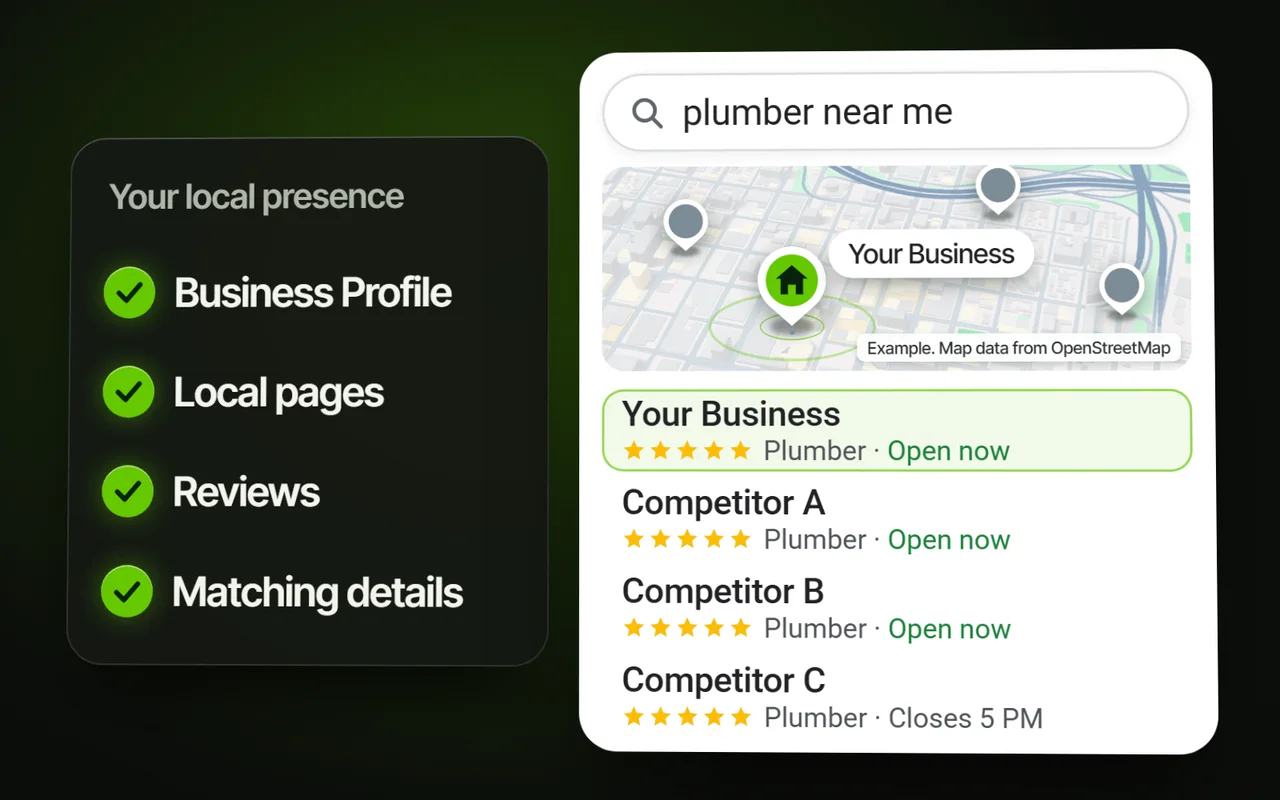
Does Your Website Prove You're Local?
Your Google Business Profile tells Google where you are. Your website tells Google, and searchers, why you're the right choice. These two signals reinforce each other, and a thin website undercuts an otherwise strong profile.
Build Pages for Each San Diego Area You Serve
A single "Service Areas" paragraph buried in your footer doesn't give Google much to work with. Dedicated pages for the communities you actually serve, Clairemont, La Mesa, Chula Vista, Encinitas, and so on, give you more surface area to rank for "near me" variations across the county. Our guide on How to Build Location Pages for San Diego Service Areas covers how to structure these without creating thin, duplicate-feeling content.
Your core service pages matter just as much. A generic "Plumbing Services" page that could belong to any company in any city gives Google weak relevance signals. Pages written around specific services, specific neighborhoods, and specific problems convert better and rank better. See How to Write Service Pages That Rank (and Convert) for the structure we use.
Two technical pieces round this out. First, site speed: Google's local algorithm and searchers themselves both penalize slow-loading pages, and mobile is where most "near me" searches happen. If your site lags on a phone, you're losing both rankings and impatient searchers. We cover the fix in Why Slow Websites Lose Leads. Second, structured data: adding schema markup for your business, services, and location helps search engines parse your pages more precisely. Our plain-English explainer is here: Schema Markup for Small Business Websites.
Are Reviews Driving or Hurting Your Near Me Rankings?
Review count, review recency, and star rating all factor into prominence, the third leg of Google's local ranking stool. A business with 150 reviews at 4.8 stars, with new reviews coming in regularly, has a structural advantage over a competitor with 20 reviews from two years ago, even if everything else is equal.
Reviews also directly influence conversion once you do show up. Searchers scanning a map pack compare star ratings and review counts before they even click. A strong profile with weak reviews still loses the click to a weaker profile with stronger social proof.
- Ask for reviews at the moment a job or sale is completed, not weeks later
- Make the review link easy to find: a text message or QR code outperforms a buried email request
- Respond to every review, positive and negative, within a few days
- Never offer incentives in exchange for reviews; it violates Google's policies and risks your profile
For a system that generates reviews consistently without feeling like begging, read How to Get More Google Reviews (No Begging). And because a single bad review handled poorly can do more damage than the review itself, Responding to Negative Google Reviews the Right Way is worth bookmarking.
What About Citations and Local Links?
Citations are mentions of your business name, address, and phone number (NAP) across the web: directories, industry associations, chambers of commerce, and review sites. Consistency matters more than volume. If your address is formatted three different ways across ten directories, Google has to work harder to confirm you're the same business everywhere, and that uncertainty can cost you rankings.
- Audit your NAP across Yelp, Apple Maps, Bing Places, and major industry directories
- Use the exact same business name, address format, and phone number everywhere
- Claim and complete profiles on directories relevant to your industry
- Prioritize accuracy over adding dozens of low-quality directory listings
Local links, mentions from San Diego news sites, local blogs, sponsorships, or partner businesses, add a further layer of prominence. These tend to build naturally over time as part of a broader local SEO strategy for San Diego businesses, rather than something to chase aggressively on their own.
How Long Does It Take to See Results?
"Near me" optimization isn't a switch you flip. It's a sequence of fixes that compound over weeks and months.
Typical optimization sequence
- FoundationClean up Google Business Profile and fix NAP inconsistenciesWeeks 1-2
- ContentPublish location pages and rewrite thin service pagesWeeks 3-6
- Reviews & citationsBuild review velocity and correct directory listingsWeeks 4-10
- MeasureTrack map pack position, calls, and direction requestsWeeks 8-12
The exact pace depends on your industry's competitiveness and how far behind your starting point is. We break this down in more detail, including what to expect month by month, in How Long Does Local SEO Take to Show Results? and Local SEO Services Explained Month by Month.
Should You Run Ads Alongside Near Me SEO?
SEO and Google Business Profile work build lasting visibility, but they take time. If you need leads now while that foundation builds, paid options fill the gap.
Local Services Ads put you at the very top of mobile search results for eligible categories with the Google Guaranteed badge, and you pay per lead rather than per click. Google Ads search campaigns let you target specific San Diego neighborhoods or zip codes directly. Many trades run both alongside organic local SEO. For a side-by-side comparison of which to start with, see Google Ads vs. Local Services Ads: Which Should Your Business Run First? and, if Local Services Ads fits your category, How Much Do Local Services Ads Cost?
Key Takeaways and Your Next Steps
Winning "near me" searches in San Diego comes down to three reinforcing pieces: a complete, accurately categorized Google Business Profile, a website with real local content and fast load times, and a steady stream of reviews and consistent citations. None of these is a one-time project. All of them need regular upkeep as Google's local algorithm and your competitors both keep moving.
This week, you can make real progress on your own:
- Log into your Google Business Profile and confirm your primary category, service list, and service area are accurate
- Search your business name and address across five directories to check for NAP inconsistencies
- Send a review request text to your last three completed jobs or orders
- Run your homepage and top service page through a mobile speed test
- List the three San Diego neighborhoods or cities that drive the most business and check whether you have a dedicated page for each
If you'd rather have a team handle the audit, the content, and the ongoing review and citation work, that's what our local SEO plans are built for, starting at $1,000 a month and covering both SEO and local SEO together. You can also book a free strategy call and we'll walk through exactly where your "near me" visibility stands today and what would move the needle fastest.